
Articles | Volume 21, issue 6
https://doi.org/10.5194/os-21-3311-2025
© Author(s) 2025. This work is distributed under
the Creative Commons Attribution 4.0 License.
the Creative Commons Attribution 4.0 License.
https://doi.org/10.5194/os-21-3311-2025
© Author(s) 2025. This work is distributed under
the Creative Commons Attribution 4.0 License.
the Creative Commons Attribution 4.0 License.
Research article
| 
04 Dec 2025
Research article |
| 04 Dec 2025
| 04 Dec 2025
Changes in water mass composition and circulation in the central Arctic Ocean between 2011 and 2021 inferred from tracer observations
Anne-Marie Wefing
CORRESPONDING AUTHOR

Department of Environmental Systems Science, ETHZ, Zurich, Switzerland
Norwegian Polar Institute, Tromsø, Norway
Annabel Payne
Department of Environmental Systems Science, ETHZ, Zurich, Switzerland
Marcel Scheiwiller
Department of Environmental Systems Science, ETHZ, Zurich, Switzerland
Christof Vockenhuber
Department of Environmental Systems Science, ETHZ, Zurich, Switzerland
Laboratory of Ion Beam Physics, ETHZ, Zurich, Switzerland
Marcus Christl
Laboratory of Ion Beam Physics, ETHZ, Zurich, Switzerland
Toste Tanhua
GEOMAR Helmholtz Centre for Ocean Research Kiel, Kiel, Germany
Núria Casacuberta
Department of Environmental Systems Science, ETHZ, Zurich, Switzerland
Laboratory of Ion Beam Physics, ETHZ, Zurich, Switzerland
Related authors

Marcel Scheiwiller, Anne-Marie Wefing, Habacuc Pérez-Tribouillier, Christof Vockenhuber, Paul A. Dodd, Justin P. Gwynn, and Núria Casacuberta
Ocean Sci., 22, 2779–2808, https://doi.org/10.5194/os-22-2779-2026, https://doi.org/10.5194/os-22-2779-2026, 2026
Short summary
Short summary
We used man-made chemical markers to study how warm Atlantic origin water moves through the Arctic Ocean. Comparing Fram Strait observations from 2016 to 2021, we found stronger mixing in 2020 and longer transit times in 2021. This variability matters because these waters carry heat into the Arctic Ocean, intensifying its warming. Our findings help improve predictions of the Arctic Ocean climate response and its wider effects on ocean circulation.
Angus Moore, Maud Henrion, Yanfei Li, Eléonore du Bois d'Aische, Philip Gautschi, Marcus Christl, François Jonard, Sébastien Lambot, Kristof Van Oost, Sophie Opfergelt, and Veerle Vanacker
Earth Surf. Dynam., 14, 763–780, https://doi.org/10.5194/esurf-14-763-2026, https://doi.org/10.5194/esurf-14-763-2026, 2026
Short summary
Short summary
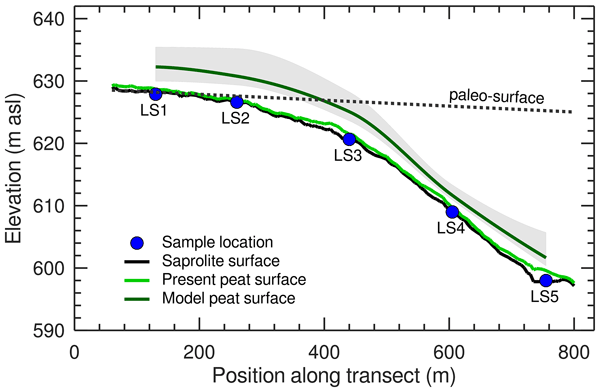
Studying peatland dynamics over long timescales requires a proxy for past peat cover. In this paper, we explore using cosmogenic nuclides to infer peat thicknesses averaged over 100 kyr timescales. We find that long-term peat thicknesses inferred from cosmogenic nuclides at an upland peatland site in the Belgian Ardennes are consistent with independent constraints, but exceed modern peat thicknesses. We attribute this discrepancy to peat degradation associated with historical land use.
Marcel Scheiwiller, Anne-Marie Wefing, Habacuc Pérez-Tribouillier, Christof Vockenhuber, Paul A. Dodd, Justin P. Gwynn, and Núria Casacuberta
Ocean Sci., 22, 2779–2808, https://doi.org/10.5194/os-22-2779-2026, https://doi.org/10.5194/os-22-2779-2026, 2026
Short summary
Short summary
We used man-made chemical markers to study how warm Atlantic origin water moves through the Arctic Ocean. Comparing Fram Strait observations from 2016 to 2021, we found stronger mixing in 2020 and longer transit times in 2021. This variability matters because these waters carry heat into the Arctic Ocean, intensifying its warming. Our findings help improve predictions of the Arctic Ocean climate response and its wider effects on ocean circulation.
Mian Liu and Toste Tanhua
Ocean Sci., 22, 2595–2620, https://doi.org/10.5194/os-22-2595-2026, https://doi.org/10.5194/os-22-2595-2026, 2026
Short summary
Short summary
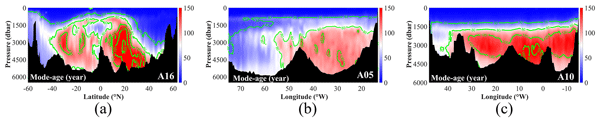
We measured the age of Atlantic waters using man-made gases and a radioactive isotope. Age increases with depth: young surface waters are about 30 years old, deep Antarctic water reaches 100 years, and the oldest bottom water is roughly 120 years. The western Atlantic is younger and better ventilated than the east. These patterns help estimate deep-sea oxygen use and are key for climate models and marine ecosystems.
Nico Lange, Siv K. Lauvset, Brendan R. Carter, Matthew P. Humphreys, Ryan J. Woosley, Are Olsen, Henry C. Bittig, Alex Kozyr, Marta Álvarez, Kumiko Azetsu-Scott, Susan Becker, Peter J. Brown, Leticia Cotrim da Cunha, Larissa Dias, Mario Hoppema, Masao Ishii, Emil Jeansson, Akihiko Murata, Jens Daniel Müller, Fiz F. Pérez, Carsten Schirnick, Reiner Steinfeldt, Adam Ulfsbo, Anton Velo, and Toste Tanhua
Earth Syst. Sci. Data Discuss., https://doi.org/10.5194/essd-2026-496, https://doi.org/10.5194/essd-2026-496, 2026
Preprint under review for ESSD
Short summary
Short summary
GLODAP is a data product for ocean inorganic carbon and related biogeochemical variables measured by the chemical analysis of water bottle samples from scientific cruises. GLODAPv3 is the third version release of GLODAP. The data that are included have been subjected to extensive quality control, including systematic evaluation of systematic cruise differences. This version contains data from 1181 hydrographic cruises covering the world's oceans from 1972 to 2023.
Marta Álvarez, Maribel I. García-Ibáñez, Nico Lange, Alex Kozyr, Antón Velo, Toste Tanhua, Giuseppe Civitarese, Carolina Cantoni, Malek Belgacem, Katrin Schroeder, Rubén Acerbi, Laurent Coppola, Thibaut Wagener, Noelia M. Fajar, Susana Flecha, Michele Giani, Louisa Giannoudi, Elisa F. Guallart, Abed El Rahman Hassoun, Emma I. Huertas, Valeria Ibello, Mehdia A. Keraghel, Férial Louanchi, Anna Luchetta, Fiz F. Pérez, Carsten Schirnick, Ekaterini Souvermezoglou, Lidia Urbini, Montserrat Vidal, and Patrizia Ziveri
Earth Syst. Sci. Data, 18, 4915–4941, https://doi.org/10.5194/essd-18-4915-2026, https://doi.org/10.5194/essd-18-4915-2026, 2026
Short summary
Short summary
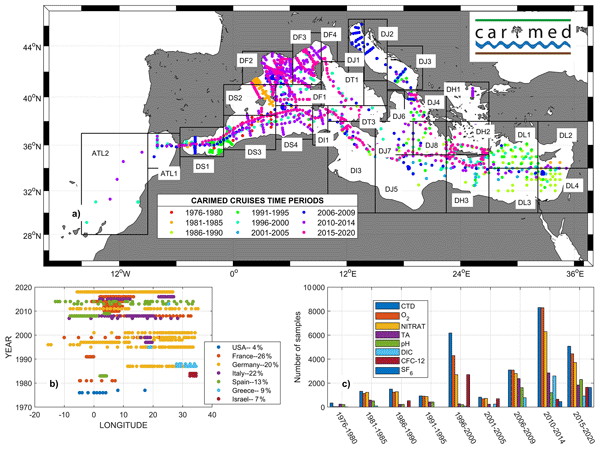
CARIMED (CARbon, tracers, and ancillary data In the MEDiterranean Sea) is a high-quality, FAIR (Findability, Accessibility, Interoperability, and Reusability) dataset integrating hydrographic, biogeochemical, and transient tracer data from 46 research cruises (1976–2018) across the Mediterranean Sea. The data underwent rigorous, basin-adapted quality control to remove systematic biases, unifying four decades of fragmented data, delivering two complementary products: the aggregated original cruise data product and the bias-adjusted data synthesis product.
Lisa G. T. Leist, Maxi Castrillejo, Kumiko Azetsu-Scott, Craig Lee, Jed Lenetsky, Marc Ringuette, Christof Vockenhuber, Habacuc Pérez-Tribouillier, Catherine Jeandel, Jean-Éric Tremblay, and Núria Casacuberta
Ocean Sci., 22, 1835–1860, https://doi.org/10.5194/os-22-1835-2026, https://doi.org/10.5194/os-22-1835-2026, 2026
Short summary
Short summary
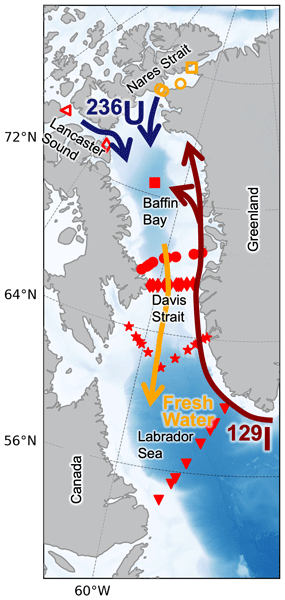
The Arctic and Atlantic Oceans are connected by narrow passages, and the exchange of waters affect global climate. Using artificial radionuclides from nuclear reprocessing discharges, we traced the origin of water masses from the Arctic to the Labrador Sea. Results show that waters from Canadian Arctic origin entering via Lancaster Sound are a key freshwater source to the Labrador Sea. These flows strongly influence the formation of deep waters in the Atlantic, vital for the global circulation.
Matthew P. Humphreys, Siv K. Lauvset, Nico Lange, Henry C. Bittig, Brendan R. Carter, Mario Hoppema, Akihiko Murata, Are Olsen, Toste Tanhua, Adam Ulfsbo, Antón Velo, Ryan J. Woosley, Kumiko Azetsu-Scott, Jens D. Müller, and Fiz F. Pérez
EGUsphere, https://doi.org/10.5194/egusphere-2026-3063, https://doi.org/10.5194/egusphere-2026-3063, 2026
Short summary
Short summary
The Global Ocean Data Analysis Project (GLODAP) collects oceanographic datasets from research cruises that are needed to study the marine carbon cycle. The datasets are quality controlled and adjusted where necessary to ensure consistency between cruises, and published as a global data product. Here, we present a new method for calculating the consistency adjustments called ‘furthest-first inversion’ which has been developed for the newest version of the data product.
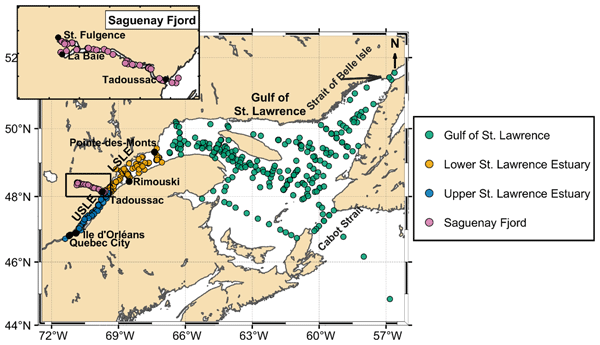
William A. Nesbitt, Alfonso O. Mucci, Toste Tanhua, Yves Gélinas, Jean-Éric Tremblay, Gwénaëlle Chaillou, Ludovic Pascal, Caroline Fradette, Lennart Gerke, Samuel W. Stevens, Mathilde Jutras, Marjolaine Blais, Martine Lizotte, Michel Starr, and Douglas W. R. Wallace
Earth Syst. Sci. Data, 18, 3609–3634, https://doi.org/10.5194/essd-18-3609-2026, https://doi.org/10.5194/essd-18-3609-2026, 2026
Short summary
Short summary
Over the past few decades, the St. Lawrence Estuary and Gulf have shown clear trends in oxygen depletion and acidification. This data description paper brings together twenty years of measurements from the St. Lawrence Estuary, Gulf of St. Lawrence, and Saguenay Fjord, carefully performing quality control procedures on data, and makes them publicly available. The resulting dataset supports future research, monitoring, and environmental management in this sensitive marine system.
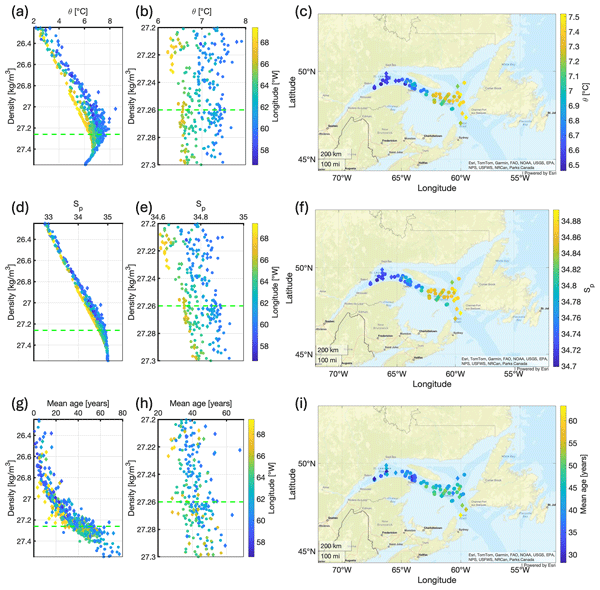
Lennart Gerke, Toste Tanhua, William A. Nesbitt, Samuel W. Stevens, and Douglas W. R. Wallace
Ocean Sci., 22, 1391–1407, https://doi.org/10.5194/os-22-1391-2026, https://doi.org/10.5194/os-22-1391-2026, 2026
Short summary
Short summary
Transient tracer data, measured for the first time in 2022 in the Gulf of St. Lawrence, reveal older deep waters in the east than the west, contrary to expected estuarine circulation, indicating increased influence of older, warmer, less oxygenated North Atlantic Central Water over younger, oxygen-rich Labrador Current Water. While consistent with previous reports of increasing NACW contribution, our results contradict claims of a complete shift to NACW by 2021, showing that LCW still persists.
Niklas Kappelt, Piers Larkman, Pascal Bohleber, Florian Adolphi, Marcus Christl, Christof Vockenhuber, Philip Gautschi, Eric Wolff, and Raimund Muscheler
EGUsphere, https://doi.org/10.5194/egusphere-2026-790, https://doi.org/10.5194/egusphere-2026-790, 2026
This preprint is open for discussion and under review for The Cryosphere (TC).
Short summary
Short summary
10Be is a radionuclide often measured in ice cores to reconstruct the solar magnetic field and geomagnetic field, as well as to date ice based on its half-life of 1.387 million years. Previous measurements in deep ice from Antarctica showed a decrease in concentrations with age. We analysed the influence of the sample preparation procedure and were able to show that the use of ion exchange columns can lead to decreasing concentrations, an effect which is amplified at greater depths and ages.
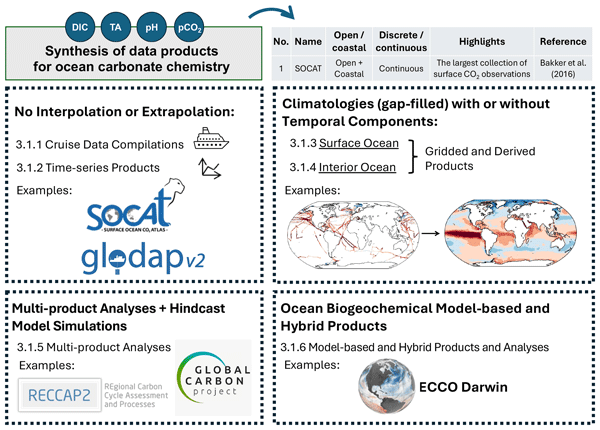
Li-Qing Jiang, Amanda Fay, Jens Daniel Müller, Luke Gregor, Alizée Roobaert, Lydia Keppler, Dustin Carroll, Siv K. Lauvset, Tim DeVries, Judith Hauck, Christian Rödenbeck, Nicolas Metzl, Andrea J. Fassbender, Jean-Pierre Gattuso, Peter Landschützer, Rik Wanninkhof, Christopher Sabine, Simone R. Alin, Mario Hoppema, Are Olsen, Matthew P. Humphreys, Kunal Chakraborty, Ana C. Franco, Kumiko Azetsu-Scott, Dorothee C. E. Bakker, Leticia Barbero, Nicholas R. Bates, Nicole Besemer, Henry C. Bittig, Albert E. Boyd, Daniel Broullón, Wei-Jun Cai, Brendan R. Carter, Thi-Tuyet-Trang Chau, Chen-Tung Arthur Chen, Frédéric Cyr, John E. Dore, Ian Enochs, Richard A. Feely, Hernan E. Garcia, Marion Gehlen, Prasanna Kanti Ghoshal, Lucas Gloege, Melchor González-Dávila, Nicolas Gruber, Debby Ianson, Yosuke Iida, Masao Ishii, Apurva Padamnabh Joshi, Esther Kennedy, Alex Kozyr, Nico Lange, Claire Lo Monaco, Derek P. Manzello, Galen A. McKinley, Natalie M. Monacci, Xose A. Padin, Ana M. Palacio-Castro, Fiz F. Pérez, J. Magdalena Santana-Casiano, Jonathan Sharp, Adrienne Sutton, Jim Swift, Toste Tanhua, Maciej Telszewski, Jens Terhaar, Ruben van Hooidonk, Anton Velo, Andrew J. Watson, Angelicque E. White, Zelun Wu, Liang Xue, Hyelim Yoo, Jiye Zeng, and Guorong Zhong
Earth Syst. Sci. Data, 18, 1405–1462, https://doi.org/10.5194/essd-18-1405-2026, https://doi.org/10.5194/essd-18-1405-2026, 2026
Short summary
Short summary
This review article provides an overview of 68 existing ocean carbonate chemistry data products and data product sets, encompassing a broad range of types, including compilations of cruise datasets, gap-filled observational products, model simulations, and more. It is designed to help researchers identify and access the data products that best support their scientific objectives, thereby facilitating progress in understanding the ocean's changing carbonate chemistry.
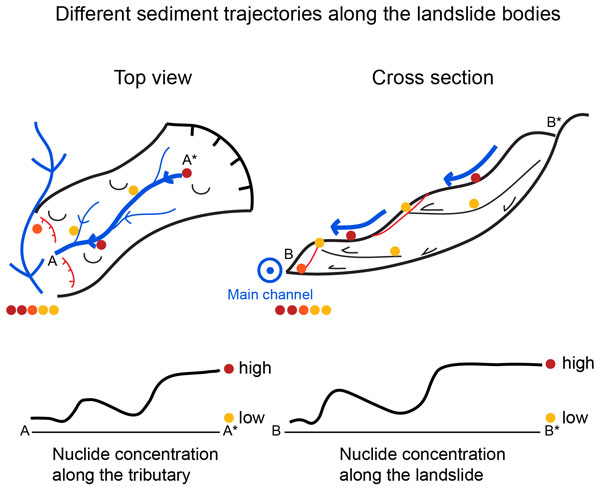
Chantal Schmidt, David Mair, Naki Akçar, Marcus Christl, Negar Haghipour, Christof Vockenhuber, Philip Gautschi, Brian McArdell, and Fritz Schlunegger
Earth Surf. Dynam., 14, 33–53, https://doi.org/10.5194/esurf-14-33-2026, https://doi.org/10.5194/esurf-14-33-2026, 2026
Short summary
Short summary
Our study examines erosion in a small, pre-Alpine basin by using cosmogenic nuclides in river sediments. Based on a dense measuring network we were able to distinguish two main zones: an upper zone with slow erosion of surface material, and a steeper, lower zone where faster erosion is driven by landslides. The data suggests that sediment has been constantly produced over thousands of years, indicating a stable, long-term balance between contrasting erosion processes.
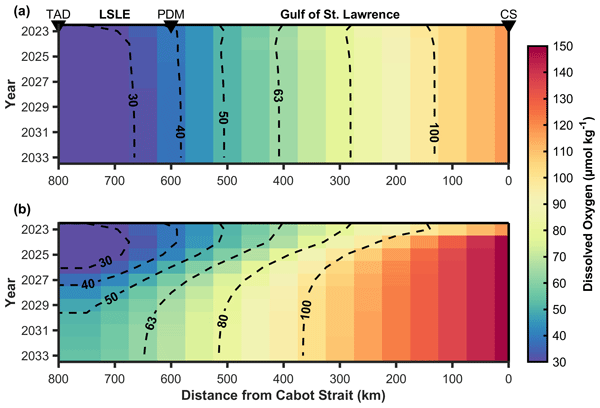
William A. Nesbitt, Samuel W. Stevens, Alfonso O. Mucci, Lennart Gerke, Toste Tanhua, Gwénaëlle Chaillou, and Douglas W. R. Wallace
Ocean Sci., 21, 2179–2195, https://doi.org/10.5194/os-21-2179-2025, https://doi.org/10.5194/os-21-2179-2025, 2025
Short summary
Short summary
We combine two decades of oxygen data with new carbon observations and a tracer-informed model to quantify oxygen loss and carbon buildup in the deep waters of the Gulf and Lower St. Lawrence Estuary. We then test a novel idea: reoxygenating these waters with the oxygen produced as a by-product from green-hydrogen production. Our results suggest this could significantly reduce hypoxia, though full recovery would require larger inputs.
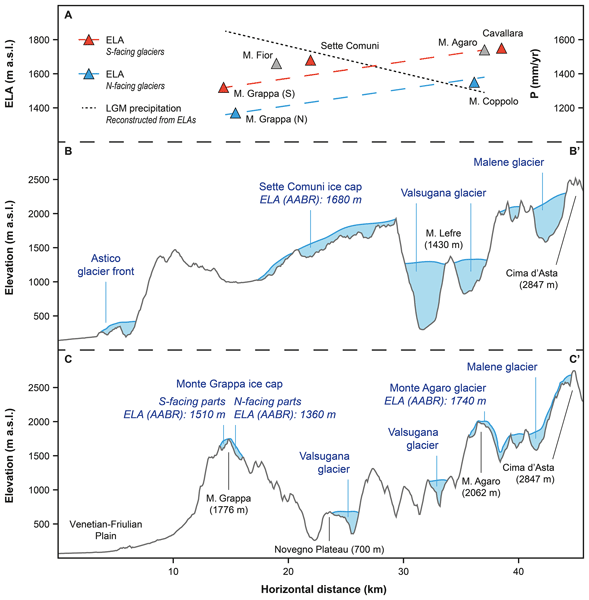
Lukas Rettig, Sandro Rossato, Sarah Kamleitner, Paolo Mozzi, Susan Ivy-Ochs, Enrico Marcato, Marcus Christl, Silvana Martin, and Giovanni Monegato
E&G Quaternary Sci. J., 74, 151–168, https://doi.org/10.5194/egqsj-74-151-2025, https://doi.org/10.5194/egqsj-74-151-2025, 2025
Short summary
Short summary
The work shows detailed reconstructions of the glaciers in the Valsugana area (south-eastern Alps) during the Last Glacial Maximum (LGM) and is supported by robust evidence and new exposure datings. These are the first ages for the internal sector of the south-eastern Alps. Local glaciers not connected with the major ice network were used for the calculation of their equilibrium line altitude. This let us estimate LGM palaeoprecipitation and compare it to Alpine palaeoclimatological models.
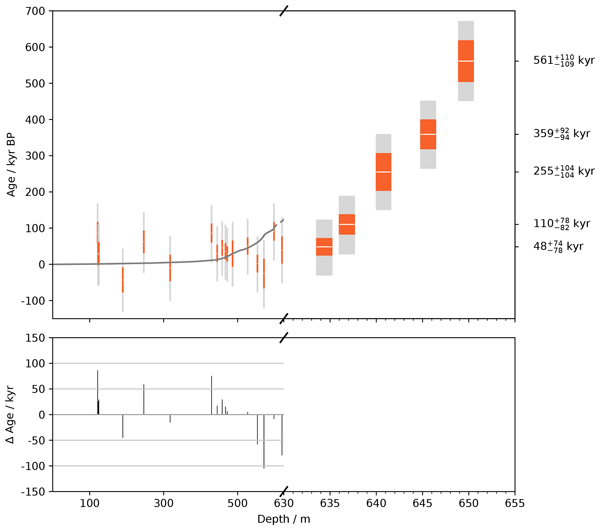
Niklas Kappelt, Eric Wolff, Marcus Christl, Christof Vockenhuber, Philip Gautschi, and Raimund Muscheler
Clim. Past, 21, 1585–1594, https://doi.org/10.5194/cp-21-1585-2025, https://doi.org/10.5194/cp-21-1585-2025, 2025
Short summary
Short summary
By measuring the radioactive decay of atmospherically produced 36Cl and 10Be in an ice core drilled in West Antarctica, we were able to determine the age of the deepest sample close to bedrock to be about 550 thousand years old. This means that the ice in this location, known as Skytrain Ice Rise, has survived several warm periods in the past, at least since marine isotope stage 11.
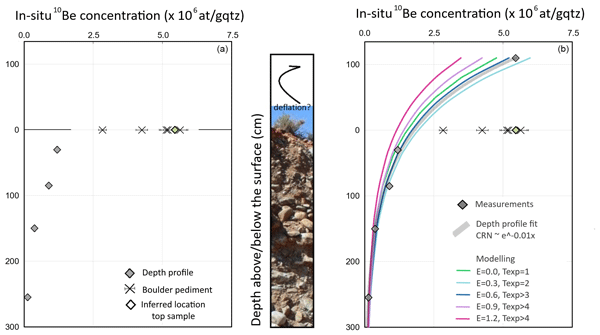
Janet C. Richardson, Veerle Vanacker, David M. Hodgson, Marcus Christl, and Andreas Lang
Earth Surf. Dynam., 13, 315–339, https://doi.org/10.5194/esurf-13-315-2025, https://doi.org/10.5194/esurf-13-315-2025, 2025
Short summary
Short summary
Pediments are long flat surfaces that extend outwards from the foot of mountains; within South Africa they are regarded as ancient landforms that can give key insights into landscape and mantle dynamics. Cosmogenic nuclide dating has been incorporated with geological (soil formation) and geomorphological (river incision) evidence, which shows that the pediments are long-lived features beyond the ages reported by cosmogenic nuclide dating.

Siv K. Lauvset, Nico Lange, Toste Tanhua, Henry C. Bittig, Are Olsen, Alex Kozyr, Marta Álvarez, Kumiko Azetsu-Scott, Peter J. Brown, Brendan R. Carter, Leticia Cotrim da Cunha, Mario Hoppema, Matthew P. Humphreys, Masao Ishii, Emil Jeansson, Akihiko Murata, Jens Daniel Müller, Fiz F. Pérez, Carsten Schirnick, Reiner Steinfeldt, Toru Suzuki, Adam Ulfsbo, Anton Velo, Ryan J. Woosley, and Robert M. Key
Earth Syst. Sci. Data, 16, 2047–2072, https://doi.org/10.5194/essd-16-2047-2024, https://doi.org/10.5194/essd-16-2047-2024, 2024
Short summary
Short summary
GLODAP is a data product for ocean inorganic carbon and related biogeochemical variables measured by the chemical analysis of water bottle samples from scientific cruises. GLODAPv2.2023 is the fifth update of GLODAPv2 from 2016. The data that are included have been subjected to extensive quality controlling, including systematic evaluation of measurement biases. This version contains data from 1108 hydrographic cruises covering the world's oceans from 1972 to 2021.
Nico Lange, Björn Fiedler, Marta Álvarez, Alice Benoit-Cattin, Heather Benway, Pier Luigi Buttigieg, Laurent Coppola, Kim Currie, Susana Flecha, Dana S. Gerlach, Makio Honda, I. Emma Huertas, Siv K. Lauvset, Frank Muller-Karger, Arne Körtzinger, Kevin M. O'Brien, Sólveig R. Ólafsdóttir, Fernando C. Pacheco, Digna Rueda-Roa, Ingunn Skjelvan, Masahide Wakita, Angelicque White, and Toste Tanhua
Earth Syst. Sci. Data, 16, 1901–1931, https://doi.org/10.5194/essd-16-1901-2024, https://doi.org/10.5194/essd-16-1901-2024, 2024
Short summary
Short summary
The Synthesis Product for Ocean Time Series (SPOTS) is a novel achievement expanding and complementing the biogeochemical data landscape by providing consistent and high-quality biogeochemical time-series data from 12 ship-based fixed time-series programs. SPOTS covers multiple unique marine environments and time-series ranges, including data from 1983 to 2021. All in all, it facilitates a variety of applications that benefit from the collective value of biogeochemical time-series observations.
Chiara I. Paleari, Florian Mekhaldi, Tobias Erhardt, Minjie Zheng, Marcus Christl, Florian Adolphi, Maria Hörhold, and Raimund Muscheler
Clim. Past, 19, 2409–2422, https://doi.org/10.5194/cp-19-2409-2023, https://doi.org/10.5194/cp-19-2409-2023, 2023
Short summary
Short summary
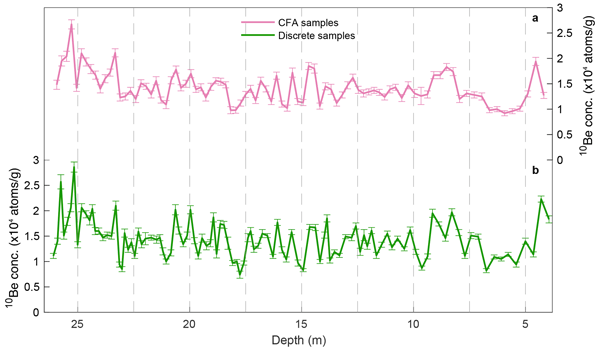
In this study, we test the use of excess meltwater from continuous flow analysis from a firn core from Greenland for the measurement of 10Be for solar activity reconstructions. We show that the quality of results is similar to the measurements on clean firn, which opens the possibility to obtain continuous 10Be records without requiring large amounts of clean ice. Furthermore, we investigate the possibility of identifying solar storm signals in 10Be records from Greenland and Antarctica.
Catharina Dieleman, Philip Deline, Susan Ivy Ochs, Patricia Hug, Jordan Aaron, Marcus Christl, and Naki Akçar
EGUsphere, https://doi.org/10.5194/egusphere-2023-1873, https://doi.org/10.5194/egusphere-2023-1873, 2023
Preprint withdrawn
Short summary
Short summary
Valleys in the Alps are shaped by glaciers, rivers, mass movements, and slope processes. An understanding of such processes is of great importance in hazard mitigation. We focused on the evolution of the Frébouge cone, which is composed of glacial, debris flow, rock avalanche, and snow avalanche deposits. Debris flows started to form the cone prior to ca. 2 ka ago. In addition, the cone was overrun by a 10 Mm3 large rock avalanche at 1.3 ± 0.1 ka and by the Frébouge glacier at 300 ± 40 a.
Giulia Sinnl, Florian Adolphi, Marcus Christl, Kees C. Welten, Thomas Woodruff, Marc Caffee, Anders Svensson, Raimund Muscheler, and Sune Olander Rasmussen
Clim. Past, 19, 1153–1175, https://doi.org/10.5194/cp-19-1153-2023, https://doi.org/10.5194/cp-19-1153-2023, 2023
Short summary
Short summary
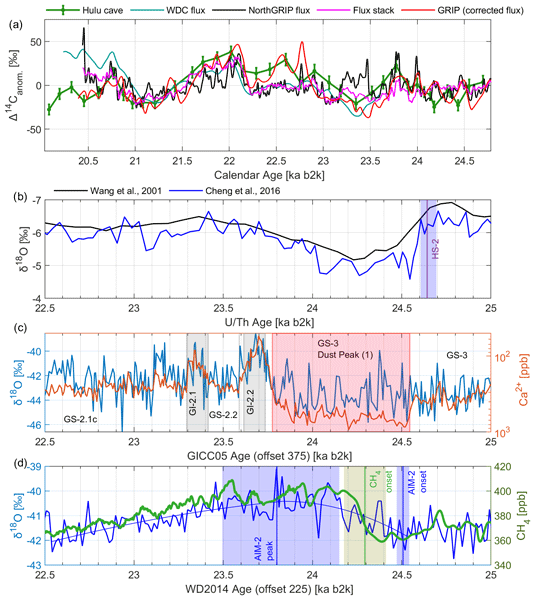
The record of past climate is preserved by several archives from different regions, such as ice cores from Greenland or Antarctica or speleothems from caves such as the Hulu Cave in China. In this study, these archives are aligned by taking advantage of the globally synchronous production of cosmogenic radionuclides. This produces a new perspective on the global climate in the period between 20 000 and 25 000 years ago.
Robert Mulvaney, Eric W. Wolff, Mackenzie M. Grieman, Helene H. Hoffmann, Jack D. Humby, Christoph Nehrbass-Ahles, Rachael H. Rhodes, Isobel F. Rowell, Frédéric Parrenin, Loïc Schmidely, Hubertus Fischer, Thomas F. Stocker, Marcus Christl, Raimund Muscheler, Amaelle Landais, and Frédéric Prié
Clim. Past, 19, 851–864, https://doi.org/10.5194/cp-19-851-2023, https://doi.org/10.5194/cp-19-851-2023, 2023
Short summary
Short summary
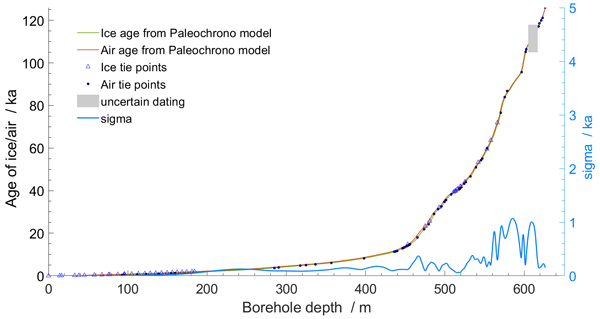
We present an age scale for a new ice core drilled at Skytrain Ice Rise, an ice rise facing the Ronne Ice Shelf in Antarctica. Various measurements in the ice and air phases are used to match the ice core to other Antarctic cores that have already been dated, and a new age scale is constructed. The 651 m ice core includes ice that is confidently dated to 117 000–126 000 years ago, in the last interglacial. Older ice is found deeper down, but there are flow disturbances in the deeper ice.
Siv K. Lauvset, Nico Lange, Toste Tanhua, Henry C. Bittig, Are Olsen, Alex Kozyr, Simone Alin, Marta Álvarez, Kumiko Azetsu-Scott, Leticia Barbero, Susan Becker, Peter J. Brown, Brendan R. Carter, Leticia Cotrim da Cunha, Richard A. Feely, Mario Hoppema, Matthew P. Humphreys, Masao Ishii, Emil Jeansson, Li-Qing Jiang, Steve D. Jones, Claire Lo Monaco, Akihiko Murata, Jens Daniel Müller, Fiz F. Pérez, Benjamin Pfeil, Carsten Schirnick, Reiner Steinfeldt, Toru Suzuki, Bronte Tilbrook, Adam Ulfsbo, Anton Velo, Ryan J. Woosley, and Robert M. Key
Earth Syst. Sci. Data, 14, 5543–5572, https://doi.org/10.5194/essd-14-5543-2022, https://doi.org/10.5194/essd-14-5543-2022, 2022
Short summary
Short summary
GLODAP is a data product for ocean inorganic carbon and related biogeochemical variables measured by the chemical analysis of water bottle samples from scientific cruises. GLODAPv2.2022 is the fourth update of GLODAPv2 from 2016. The data that are included have been subjected to extensive quality controlling, including systematic evaluation of measurement biases. This version contains data from 1085 hydrographic cruises covering the world's oceans from 1972 to 2021.
Nathan Vandermaelen, Koen Beerten, François Clapuyt, Marcus Christl, and Veerle Vanacker
Geochronology, 4, 713–730, https://doi.org/10.5194/gchron-4-713-2022, https://doi.org/10.5194/gchron-4-713-2022, 2022
Short summary
Short summary
We constrained deposition phases of fluvial sediments (NE Belgium) over the last 1 Myr with analysis and modelling of rare isotopes accumulation within sediments, occurring as a function of time and inverse function of depth. They allowed the determination of three superposed deposition phases and intercalated non-deposition periods of ~ 40 kyr each. These phases correspond to 20 % of the sediment age, which highlights the importance of considering deposition phase when dating fluvial sediments.
Pierre Friedlingstein, Michael O'Sullivan, Matthew W. Jones, Robbie M. Andrew, Luke Gregor, Judith Hauck, Corinne Le Quéré, Ingrid T. Luijkx, Are Olsen, Glen P. Peters, Wouter Peters, Julia Pongratz, Clemens Schwingshackl, Stephen Sitch, Josep G. Canadell, Philippe Ciais, Robert B. Jackson, Simone R. Alin, Ramdane Alkama, Almut Arneth, Vivek K. Arora, Nicholas R. Bates, Meike Becker, Nicolas Bellouin, Henry C. Bittig, Laurent Bopp, Frédéric Chevallier, Louise P. Chini, Margot Cronin, Wiley Evans, Stefanie Falk, Richard A. Feely, Thomas Gasser, Marion Gehlen, Thanos Gkritzalis, Lucas Gloege, Giacomo Grassi, Nicolas Gruber, Özgür Gürses, Ian Harris, Matthew Hefner, Richard A. Houghton, George C. Hurtt, Yosuke Iida, Tatiana Ilyina, Atul K. Jain, Annika Jersild, Koji Kadono, Etsushi Kato, Daniel Kennedy, Kees Klein Goldewijk, Jürgen Knauer, Jan Ivar Korsbakken, Peter Landschützer, Nathalie Lefèvre, Keith Lindsay, Junjie Liu, Zhu Liu, Gregg Marland, Nicolas Mayot, Matthew J. McGrath, Nicolas Metzl, Natalie M. Monacci, David R. Munro, Shin-Ichiro Nakaoka, Yosuke Niwa, Kevin O'Brien, Tsuneo Ono, Paul I. Palmer, Naiqing Pan, Denis Pierrot, Katie Pocock, Benjamin Poulter, Laure Resplandy, Eddy Robertson, Christian Rödenbeck, Carmen Rodriguez, Thais M. Rosan, Jörg Schwinger, Roland Séférian, Jamie D. Shutler, Ingunn Skjelvan, Tobias Steinhoff, Qing Sun, Adrienne J. Sutton, Colm Sweeney, Shintaro Takao, Toste Tanhua, Pieter P. Tans, Xiangjun Tian, Hanqin Tian, Bronte Tilbrook, Hiroyuki Tsujino, Francesco Tubiello, Guido R. van der Werf, Anthony P. Walker, Rik Wanninkhof, Chris Whitehead, Anna Willstrand Wranne, Rebecca Wright, Wenping Yuan, Chao Yue, Xu Yue, Sönke Zaehle, Jiye Zeng, and Bo Zheng
Earth Syst. Sci. Data, 14, 4811–4900, https://doi.org/10.5194/essd-14-4811-2022, https://doi.org/10.5194/essd-14-4811-2022, 2022
Short summary
Short summary
The Global Carbon Budget 2022 describes the datasets and methodology used to quantify the anthropogenic emissions of carbon dioxide (CO2) and their partitioning among the atmosphere, the land ecosystems, and the ocean. These living datasets are updated every year to provide the highest transparency and traceability in the reporting of CO2, the key driver of climate change.
Rainer Kiko, Marc Picheral, David Antoine, Marcel Babin, Léo Berline, Tristan Biard, Emmanuel Boss, Peter Brandt, Francois Carlotti, Svenja Christiansen, Laurent Coppola, Leandro de la Cruz, Emilie Diamond-Riquier, Xavier Durrieu de Madron, Amanda Elineau, Gabriel Gorsky, Lionel Guidi, Helena Hauss, Jean-Olivier Irisson, Lee Karp-Boss, Johannes Karstensen, Dong-gyun Kim, Rachel M. Lekanoff, Fabien Lombard, Rubens M. Lopes, Claudie Marec, Andrew M. P. McDonnell, Daniela Niemeyer, Margaux Noyon, Stephanie H. O'Daly, Mark D. Ohman, Jessica L. Pretty, Andreas Rogge, Sarah Searson, Masashi Shibata, Yuji Tanaka, Toste Tanhua, Jan Taucher, Emilia Trudnowska, Jessica S. Turner, Anya Waite, and Lars Stemmann
Earth Syst. Sci. Data, 14, 4315–4337, https://doi.org/10.5194/essd-14-4315-2022, https://doi.org/10.5194/essd-14-4315-2022, 2022
Short summary
Short summary
The term
marine particlescomprises detrital aggregates; fecal pellets; bacterioplankton, phytoplankton and zooplankton; and even fish. Here, we present a global dataset that contains 8805 vertical particle size distribution profiles obtained with Underwater Vision Profiler 5 (UVP5) camera systems. These data are valuable to the scientific community, as they can be used to constrain important biogeochemical processes in the ocean, such as the flux of carbon to the deep sea.

Joanne Elkadi, Benjamin Lehmann, Georgina E. King, Olivia Steinemann, Susan Ivy-Ochs, Marcus Christl, and Frédéric Herman
Earth Surf. Dynam., 10, 909–928, https://doi.org/10.5194/esurf-10-909-2022, https://doi.org/10.5194/esurf-10-909-2022, 2022
Short summary
Short summary
Glacial and non-glacial processes have left a strong imprint on the landscape of the European Alps, but further research is needed to better understand their long-term effects. We apply a new technique combining two methods for bedrock surface dating to calculate post-glacier erosion rates next to a Swiss glacier. Interestingly, the results suggest non-glacial erosion rates are higher than previously thought, but glacial erosion remains the most influential on landscape evolution.
Elena Serra, Pierre G. Valla, Romain Delunel, Natacha Gribenski, Marcus Christl, and Naki Akçar
Earth Surf. Dynam., 10, 493–512, https://doi.org/10.5194/esurf-10-493-2022, https://doi.org/10.5194/esurf-10-493-2022, 2022
Short summary
Short summary
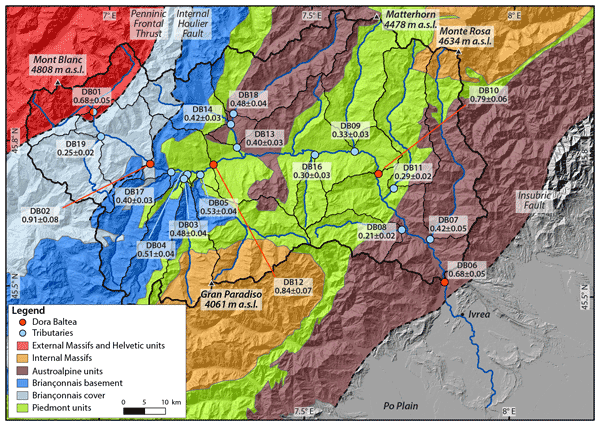
Alpine landscapes are transformed by several erosion processes. 10Be concentrations measured in river sediments at the outlet of a basin represent a powerful tool to quantify how fast the catchment erodes. We measured erosion rates within the Dora Baltea catchments (western Italian Alps). Our results show that erosion is governed by topography, bedrock resistance and glacial imprint. The Mont Blanc massif has the highest erosion and therefore dominates the sediment flux of the Dora Baltea river.
Pierre Friedlingstein, Matthew W. Jones, Michael O'Sullivan, Robbie M. Andrew, Dorothee C. E. Bakker, Judith Hauck, Corinne Le Quéré, Glen P. Peters, Wouter Peters, Julia Pongratz, Stephen Sitch, Josep G. Canadell, Philippe Ciais, Rob B. Jackson, Simone R. Alin, Peter Anthoni, Nicholas R. Bates, Meike Becker, Nicolas Bellouin, Laurent Bopp, Thi Tuyet Trang Chau, Frédéric Chevallier, Louise P. Chini, Margot Cronin, Kim I. Currie, Bertrand Decharme, Laique M. Djeutchouang, Xinyu Dou, Wiley Evans, Richard A. Feely, Liang Feng, Thomas Gasser, Dennis Gilfillan, Thanos Gkritzalis, Giacomo Grassi, Luke Gregor, Nicolas Gruber, Özgür Gürses, Ian Harris, Richard A. Houghton, George C. Hurtt, Yosuke Iida, Tatiana Ilyina, Ingrid T. Luijkx, Atul Jain, Steve D. Jones, Etsushi Kato, Daniel Kennedy, Kees Klein Goldewijk, Jürgen Knauer, Jan Ivar Korsbakken, Arne Körtzinger, Peter Landschützer, Siv K. Lauvset, Nathalie Lefèvre, Sebastian Lienert, Junjie Liu, Gregg Marland, Patrick C. McGuire, Joe R. Melton, David R. Munro, Julia E. M. S. Nabel, Shin-Ichiro Nakaoka, Yosuke Niwa, Tsuneo Ono, Denis Pierrot, Benjamin Poulter, Gregor Rehder, Laure Resplandy, Eddy Robertson, Christian Rödenbeck, Thais M. Rosan, Jörg Schwinger, Clemens Schwingshackl, Roland Séférian, Adrienne J. Sutton, Colm Sweeney, Toste Tanhua, Pieter P. Tans, Hanqin Tian, Bronte Tilbrook, Francesco Tubiello, Guido R. van der Werf, Nicolas Vuichard, Chisato Wada, Rik Wanninkhof, Andrew J. Watson, David Willis, Andrew J. Wiltshire, Wenping Yuan, Chao Yue, Xu Yue, Sönke Zaehle, and Jiye Zeng
Earth Syst. Sci. Data, 14, 1917–2005, https://doi.org/10.5194/essd-14-1917-2022, https://doi.org/10.5194/essd-14-1917-2022, 2022
Short summary
Short summary
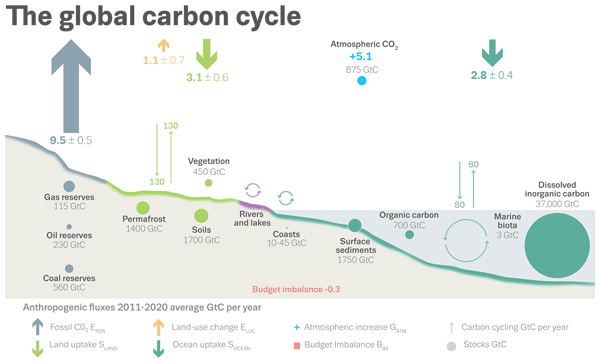
The Global Carbon Budget 2021 describes the data sets and methodology used to quantify the emissions of carbon dioxide and their partitioning among the atmosphere, land, and ocean. These living data are updated every year to provide the highest transparency and traceability in the reporting of CO2, the key driver of climate change.
Siv K. Lauvset, Nico Lange, Toste Tanhua, Henry C. Bittig, Are Olsen, Alex Kozyr, Marta Álvarez, Susan Becker, Peter J. Brown, Brendan R. Carter, Leticia Cotrim da Cunha, Richard A. Feely, Steven van Heuven, Mario Hoppema, Masao Ishii, Emil Jeansson, Sara Jutterström, Steve D. Jones, Maren K. Karlsen, Claire Lo Monaco, Patrick Michaelis, Akihiko Murata, Fiz F. Pérez, Benjamin Pfeil, Carsten Schirnick, Reiner Steinfeldt, Toru Suzuki, Bronte Tilbrook, Anton Velo, Rik Wanninkhof, Ryan J. Woosley, and Robert M. Key
Earth Syst. Sci. Data, 13, 5565–5589, https://doi.org/10.5194/essd-13-5565-2021, https://doi.org/10.5194/essd-13-5565-2021, 2021
Short summary
Short summary
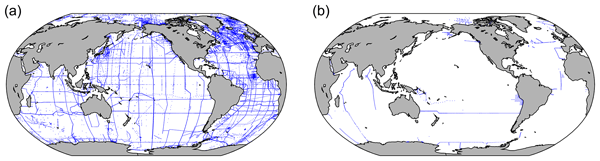
GLODAP is a data product for ocean inorganic carbon and related biogeochemical variables measured by the chemical analysis of water bottle samples from scientific cruises. GLODAPv2.2021 is the third update of GLODAPv2 from 2016. The data that are included have been subjected to extensive quality control, including systematic evaluation of measurement biases. This version contains data from 989 hydrographic cruises covering the world's oceans from 1972 to 2020.
Cited articles
Aagaard, K. and Carmack, E. C.: The role of sea ice and other fresh water in the Arctic circulation, Journal of Geophysical Research: Oceans, 94, 14485–14498, https://doi.org/10.1029/JC094iC10p14485, 1989. a
Aagaard, K., Swift, J., and Carmack, E.: Thermohaline circulation in the Arctic Mediterranean seas, Journal of Geophysical Research: Oceans, 90, 4833–4846, 1985. a
Abot, L., Provost, C., and Poli, L.: Recent Convection Decline in the Greenland Sea: Insights From the Mercator Ocean System Over 2008–2020, Journal of Geophysical Research: Oceans, 128, e2022JC019320, https://doi.org/10.1029/2022JC019320, 2023. a
Alkire, M. B., Morison, J., and Andersen, R.: Variability in the meteoric water, sea-ice melt, and Pacific water contributions to the central Arctic Ocean, 2000-2014, Journal of Geophysical Research: Oceans, 120, 1573–1598, https://doi.org/10.1002/2014JC010023, 2015. a, b
Alkire, M. B., Rember, R., and Polyakov, I.: Discrepancy in the Identification of the Atlantic/Pacific Front in the Central Arctic Ocean: NO Versus Nutrient Relationships, Geophysical Research Letters, 46, 3843–3852, https://doi.org/10.1029/2018GL081837, 2019. a, b, c, d
Anderson, L. G. and Jones, E. P.: Tracing upper waters of the Nansen Basin in the Arctic Ocean, Deep Sea Research Part A. Oceanographic Research Papers, 39, S425–S433, 1992. a
Anderson, L. G., Björk, G., Holby, O., Jutterström, S., Mörth, C. M., O'Regan, M., Pearce, C., Semiletov, I., Stranne, C., Stöven, T., Tanhua, T., Ulfsbo, A., and Jakobsson, M.: Shelf–Basin interaction along the East Siberian Sea, Ocean Sci., 13, 349–363, https://doi.org/10.5194/os-13-349-2017, 2017. a
Ardyna, M. and Arrigo, K. R.: Phytoplankton dynamics in a changing Arctic Ocean, Nature Climate Change, 10, 892–903, https://doi.org/10.1038/s41558-020-0905-y, 2020. a
Azetsu-Scott, K., Petrie, B., Yeats, P., and Lee, C.: Composition and fluxes of freshwater through Davis Strait using multiple chemical tracers, Journal of Geophysical Research: Oceans, 117, https://doi.org/10.1029/2012JC008172, 2012. a
Bakker, K.: Nutrients measured on water bottle samples during POLARSTERN cruise ARK-XXVII/3 (IceArc) in 2012 [data set], PANGAEA, https://doi.org/10.1594/PANGAEA.834081, 2014 a
Bauch, D., Schlosser, P., and Fairbanks, R. G.: Freshwater balance and the sources of deep and bottom waters in the Arctic Ocean inferred from the distribution of H
Brakstad, A., Våge, K., Håvik, L., and Moore, G. W. K.: Water Mass Transformation in the Greenland Sea during the Period 1986–2016, Journal of Physical Oceanography, 49, 121–140, https://doi.org/10.1175/JPO-D-17-0273.1, 2019. a
Broecker, W. S.: “NO”, a conservative water-mass tracer, Earth and Planetary Science Letters, 23, 100–107, https://doi.org/10.1016/0012-821X(74)90036-3, 1974. a, b
Carmack, E. C.: The Arctic Ocean’s Freshwater Budget: Sources, Storage and Export, in: The Freshwater Budget of the Arctic Ocean, edited by: Lewis, E. L., Jones, E. P., Lemke, P., Prowse, T. D., and Wadhams, P., Springer Netherlands, Dordrecht, 91–126, ISBN 978-94-011-4132-1, https://doi.org/10.1007/978-94-011-4132-1_5, 2000. a
Casacuberta, N., Masqué, P., Henderson, G., Rutgers van-der Loeff, M., Bauch, D., Vockenhuber, C., Daraoui, A., Walther, C., Synal, H.-A., and Christl, M.: First 236U data from the Arctic Ocean and use of
Casacuberta, N., Christl, M., Vockenhuber, C., Wefing, A.-M., Wacker, L., Masqué, P., Synal, H.-A., and Rutgers van der Loeff, M.: Tracing the Three Atlantic Branches Entering the Arctic Ocean With 129I and 236U, Journal of Geophysical Research: Oceans, 123, 6909–6921, https://doi.org/10.1029/2018JC014168, 2018. a, b, c, d, e, f, g
Chamizo, E., Christl, M., López-Lora, M., Casacuberta, N., Wefing, A., and Kenna, T. C.: The Potential of 233U/236U as a Water Mass Tracer in the Arctic Ocean, Journal of Geophysical Research, 127, 12, https://doi.org/10.1029/2021JC017790, 2022. a, b
Chapman, W. L. and Walsh, J. E.: Recent Variations of Sea Ice and Air Temperature in High Latitudes, Bulletin of the American Meteorological Society, 74, 33–48, https://doi.org/10.1175/1520-0477(1993)074<0033:RVOSIA>2.0.CO;2, 1993. a
Christl, M., Vockenhuber, C., Kubik, P., Wacker, L., Lachner, J., Alfimov, V., and Synal, H.-A.: The ETH Zurich AMS facilities: Performance parameters and reference materials, Nuclear Instruments and Methods in Physics Research Section B: Beam Interactions with Materials and Atoms, 294, 29–38, https://doi.org/10.1016/j.nimb.2012.03.004, 2013. a
Christl, M., Casacuberta, N., Lachner, J., Maxeiner, S., Vockenhuber, C., Synal, H.-A., Goroncy, I., Herrmann, J., Daraoui, A., Walther, C., and Michel, R.: Status of 236U analyses at ETH Zurich and the distribution of 236U and 129I in the North Sea in 2009, Nuclear Instruments and Methods in Physics Research Section B: Beam Interactions with Materials and Atoms, 361, 510–516, https://doi.org/10.1016/j.nimb.2015.01.005, 2015a. a
Christl, M., Casacuberta, N., Vockenhuber, C., Elsässer, C., Bailly du Bois, P., Herrmann, J., and Synal, H.-A.: Reconstruction of the 236U input function for the Northeast Atlantic Ocean: Implications for
Christl, M., Gautschi, P., Maxeiner, S., Müller, A. M., Vockenhuber, C., and Synal, H.-A.: 236U analyses with the ETH Zurich MILEA prototype system, Nuclear Instruments and Methods in Physics Research Section B: Beam Interactions with Materials and Atoms, 534, 61–71, https://doi.org/10.1016/j.nimb.2022.11.009, 2023. a
Coachman, L. and Barnes, C.: The contribution of Bering Sea water to the Arctic Ocean, Arctic, 14, 147–161, 1961. a
Cooper, L. W., Hong, G. H., Beasley, T. M., and Grebmeier, J. M.: Iodine-129 concentrations in marginal seas of the North Pacific and Pacific-influenced waters of the Arctic Ocean, Marine Pollution Bulletin, 42, 1347–1356, 2001. a
Crameri, F.: Scientific colour maps, Zenodo [code], https://doi.org/10.5281/zenodo.8409685, 2023. a
de Steur, L., Steele, M., Hansen, E., Morison, J., Polyakov, I., Olsen, S. M., Melling, H., McLaughlin, F. A., Kwok Jr., R., Smethie Jr., W. M., and Schlosser, P.: Hydrographic changes in the Lincoln Sea in the Arctic Ocean with focus on an upper ocean freshwater anomaly between 2007 and 2010, Journal of Geophysical Research: Oceans, 118, https://doi.org/10.1002/jgrc.20341, 2013. a
Dmitrenko, I. A., Polyakov, I. V., Kirillov, S. A., Timokhov, L. A., Frolov, I. E., Sokolov, V. T., Simmons, H. L., Ivanov, V. V., and Walsh, D.: Toward a warmer Arctic Ocean: Spreading of the early 21st century Atlantic Water warm anomaly along the Eurasian Basin margins, Journal of Geophysical Research, 113, C05023, https://doi.org/10.1029/2007JC004158, 2008. a
Edmonds, H.: Nuclear Fuel Reprocessing And Related Discharges, in: Encyclopedia of Ocean Sciences, Elsevier, 1921–1928, ISBN 978-0-12-227430-5, https://doi.org/10.1006/rwos.2001.0169, 2001. a
Frank, M., Smethie Jr., W. M., and Bayer, R.: Investigation of subsurface water flow along the continental margin of the Eurasian Basin using the transient tracers tritium, 3He, and CFCs, Journal of Geophysical Research: Oceans, 103, 30773–30792, https://doi.org/10.1029/1998JC900003,1998. a
Gascard, J.-C., Raisbeck, G., Sequeira, S., Yiou, F., and Mork, K. A.: The Norwegian Atlantic Current in the Lofoten basin inferred from hydrological and tracer data (129I) and its interaction with the Norwegian Coastal Current, Geophysical Research Letters, 31, https://doi.org/10.1029/2003GL018303, 2004. a
GEBCO Compilation Group: GEBCO 2024 Grid, National Oceanography Centre [data set], https://doi.org/10.5285/1c44ce99-0a0d-5f4f-e063-7086abc0ea0f, 2024. a
GEOTRACES Intermediate Data Product Group (2021): The GEOTRACES Intermediate Data Product 2021 (IDP2021), NERC EDS British Oceanographic Data Centre NOC [data set], https://doi.org/10.5285/cf2d9ba9-d51d-3b7c-e053-8486abc0f5fd, 2021. a
Haine, T. W. N. and Hall, T. M.: A Generalized Transport Theory: Water-Mass Composition and Age, Journal of Physical Oceanography, 32, 1932–1946, https://doi.org/10.1175/1520-0485(2002)032<1932:AGTTWM>2.0.CO;2, 2002. a
Henley, S. F., Porter, M., Hobbs, L., Braun, J., Guillaume-Castel, R., Venables, E. J., Dumont, E., and Cottier, F.: Nitrate supply and uptake in the Atlantic Arctic sea ice zone: seasonal cycle, mechanisms and drivers, Philosophical Transactions of the Royal Society A: Mathematical, Physical and Engineering Sciences, 378, 20190361, https://doi.org/10.1098/rsta.2019.0361, 2020. a
Heuzé, C., Karam, S., Muchowski, J., Padilla, A., Stranne, C., Gerke, L., Tanhua, T., Ulfsbo, A., Laber, C., and Stedmon, C. A.: Physical Oceanography during ODEN expedition SO21 for the Synoptic Arctic Survey, PANGAEA [data set], https://doi.org/10.1594/PANGAEA.951266, 2022a. a, b
Heuzé, C., Karam, S., Muchowski, J., Padilla, A., Stranne, C., Gerke, L., Tanhua, T., Ulfsbo, A., Laber, C., and Stedmon, C. A.: Physical Oceanography measured on bottle water samples during ODEN expedition SO21 for the Synoptic Arctic Survey, PANGAEA [data set], https://doi.org/10.1594/PANGAEA.951264, 2022b. a, b
Ingvaldsen, R. B., Assmann, K. M., Primicerio, R., Fossheim, M., Polyakov, I. V., and Dolgov, A. V.: Physical manifestations and ecological implications of Arctic Atlantification, Nature Reviews Earth & Environment, 2, 874–889, https://doi.org/10.1038/s43017-021-00228-x, 2021. a
Jones, E. P. and Anderson, L. G.: On the origin of the chemical properties of the Arctic Ocean halocline, Journal of Geophysical Research, 91, 10759, https://doi.org/10.1029/JC091iC09p10759, 1986. a
Jones, E. P., Anderson, L. G., and Swift, J. H.: Distribution of Atlantic and Pacific waters in the upper Arctic Ocean: Implications for circulation, Geophysical Research Letters, 25, 765–768, https://doi.org/10.1029/98GL00464, 1998. a, b
Juranek, L. W.: Changing Biogeochemistry of the Arctic Ocean: Surface Nutrient and Co? Cycling in a Warming, Melting North, Oceanography, 35, 144–155, https://www.jstor.org/stable/27182708 (last access: 25 September 2025), 2022. a
Karcher, M., Smith, J. N., Kauker, F., Gerdes, R., and Smethie, W. M.: Recent changes in Arctic Ocean circulation revealed by iodine-129 observations and modeling, Journal of Geophysical Research: Oceans, 117, https://doi.org/10.1029/2011JC007513, 2012. a
Karpouzoglou, T., de Steur, L., Smedsrud, L. H., and Sumata, H.: Observed Changes in the Arctic Freshwater Outflow in Fram Strait, Journal of Geophysical Research: Oceans, 127, https://doi.org/10.1029/2021JC018122, 2022. a
Kattner, G. and Ludwichowski, K.: Inorganic nutrients measured on water bottle samples during POLARSTERN cruise ARK-XXVI/3 (TransArc) [data set], Alfred Wegener Institute, Helmholtz Centre for Polar and Marine Research, Bremerhaven, PANGAEA, https://doi.org/10.1594/PANGAEA.832164, 2014. a
Khatiwala, S., Tanhua, T., Mikaloff Fletcher, S., Gerber, M., Doney, S. C., Graven, H. D., Gruber, N., McKinley, G. A., Murata, A., Ríos, A. F., and Sabine, C. L.: Global ocean storage of anthropogenic carbon, Biogeosciences, 10, 2169–2191, https://doi.org/10.5194/bg-10-2169-2013, 2013. a
Kohlbach, D., Fransson, A., Amargant-Arumi, M., Assmann, K. M., Assmy, P., Bratbak, G., Chierici, M., Cristea, A., Divine, D. V., Down, E., Eikrem, W., Foss, Ø., Gardner, J., Gradinger, R. R., Granskog, M. A., Hess, S., Ingvaldsen, R. B., Koenig, Z., Kwaśniewski, S., Majaneva, S., Marquardt, M., Müller, O., Ntniou, I. V., Ormańczyk, M., Raffel, B., Renaud, P., Renner, A. H. H., De Freitas, T. R., Sen, A., Smoła, Z., Svensen, C., Vader, A., Våge, S., Wiktor, J., Wold, A., Zabłocka, M., Ziegler, A., and Bluhm, B. A.: Nansen and Amundsen basins: Gradients of physico-chemical properties and biota composition with implications for future resource management of the central Arctic Ocean, Elem. Sci. Anth., 13, 00016, https://doi.org/10.1525/elementa.2024.00016, 2025. a
Korhonen, M., Rudels, B., Marnela, M., Wisotzki, A., and Zhao, J.: Time and space variability of freshwater content, heat content and seasonal ice melt in the Arctic Ocean from 1991 to 2011, Ocean Sci., 9, 1015–1055, https://doi.org/10.5194/os-9-1015-2013, 2013. a, b
Kwok, R.: Arctic sea ice thickness, volume, and multiyear ice coverage: losses and coupled variability (1958–2018), Environmental Research Letters, 13, 105005, https://doi.org/10.1088/1748-9326/aae3ec, 2018. a
Lauvset, S. K., Lange, N., Tanhua, T., Bittig, H. C., Olsen, A., Kozyr, A., Álvarez, M., Azetsu-Scott, K., Brown, P. J., Carter, B. R., Cotrim da Cunha, L., Hoppema, M., Humphreys, M. P., Ishii, M., Jeansson, E., Murata, A., Müller, J. D., Pérez, F. F., Schirnick, C., Steinfeldt, R., Suzuki, T., Ulfsbo, A., Velo, A., Woosley, R. J., and Key, R. M.: The annual update GLODAPv2.2023: the global interior ocean biogeochemical data product, Earth Syst. Sci. Data, 16, 2047–2072, https://doi.org/10.5194/essd-16-2047-2024, 2024 (data available at: https://glodap.info/index.php/merged-and-adjusted-data-product-v2-2023/, last access: 17 June 2024). a, b
Le Bras, I., Straneo, F., Muilwijk, M., Smedsrud, L. H., Li, F., Lozier, M. S., and Holliday, N. P.: How Much Arctic Fresh Water Participates in the Subpolar Overturning Circulation?, Journal of Physical Oceanography, 51, 955–973, https://doi.org/10.1175/JPO-D-20-0240.1, 2021. a
Li, J., Lin, P., Pickart, R. S., and Yang, X.: Time Dependent Flow of Atlantic Water on the Continental Slope of the Beaufort Sea Based on Moorings, Journal of Geophysical Research: Oceans, 126, https://doi.org/10.1029/2020JC016996, 2021. a
Manabe, S. and Stouffer, R. J.: Simulation of abrupt climate change induced by freshwater input to the North Atlantic Ocean, Nature, 378, 165–167, https://doi.org/10.1038/378165a0, 1995. a
Marnela, M., Rudels, B., Olsson, K. A., Anderson, L. G., Jeansson, E., Torres, D. J., Messias, M.-J., Swift, J. H., and Watson, A. J.: Transports of Nordic Seas water masses and excess SF6 through Fram Strait to the Arctic Ocean, Progress in Oceanography, 78, 1–11, https://doi.org/10.1016/j.pocean.2007.06.004, 2008. a
McLaughlin, F. A., Carmack, E. C., Macdonald, R. W., and Bishop, J. K. B.: Physical and geochemical properties across the Atlantic/Pacific water mass front in the southern Canadian Basin, Journal of Geophysical Research: Oceans, 101, 1183–1197, https://doi.org/10.1029/95JC02634, 1996. a
Morison, J., Kwok, R., Peralta-Ferriz, C., Alkire, M., Rigor, I., Andersen, R., and Steele, M.: Changing Arctic Ocean freshwater pathways, Nature, 481, 66–70, https://doi.org/10.1038/nature10705, 2012. a, b, c
Morison, J., Kwok, R., Dickinson, S., Andersen, R., Peralta-Ferriz, C., Morison, D., Rigor, I., Dewey, S., and Guthrie, J.: The Cyclonic Mode of Arctic Ocean Circulation, Journal of Physical Oceanography, 51, 1053–1075, https://doi.org/10.1175/JPO-D-20-0190.1, 2021. a, b
Newton, J. L. and Sotirin, B. J.: Boundary undercurrent and water mass changes in the Lincoln Sea, Journal of Geophysical Research: Oceans, 102, 3393–3403, https://doi.org/10.1029/96JC03441, 1997. a
Newton, R., Schlosser, P., Mortlock, R., Swift, J., and MacDonald, R.: Canadian Basin freshwater sources and changes: Results from the 2005 Arctic Ocean Section, Journal of Geophysical Research: Oceans, 118, 2133–2154, https://doi.org/10.1002/jgrc.20101, 2013. a
Östlund, H. G. and Hut, G.: Arctic Ocean water mass balance from isotope data, Journal of Geophysical Research, 89, 6373, https://doi.org/10.1029/JC089iC04p06373, 1984. a
Paffrath, R., Laukert, G., Bauch, D., Rutgers van der Loeff, M., and Pahnke, K.: Separating individual contributions of major Siberian rivers in the Transpolar Drift of the Arctic Ocean, Scientific Reports, 11, 8216, https://doi.org/10.1038/s41598-021-86948-y, 2021. a
Pasqualini, A., Schlosser, P., Newton, R., Smethie Jr, W. M., and Friedrich, R.: A Multi-Decade Tracer Study of the Circulation and Spreading Rates of Atlantic Water in the Arctic Ocean, Journal of Geophysical Research: Oceans, 129, https://doi.org/10.1029/2023JC020738, 2024. a
Payne, A., Wefing, M., Christl, M., Vockenhuber, C., Williams, W., Smith, J. N., and Casacuberta, N.: Circulation Timescales and Pathways of Atlantic Water in the Canada Basin: Insights From Transient Tracers 129I and 236U, Journal of Geophysical Research, https://doi.org/10.1029/2023JC020813, 2024. a, b, c, d, e, f, g, h, i
Polyakov, I. V., Beszczynska, A., Carmack, E. C., Dmitrenko, I. A., Fahrbach, E., Frolov, I. E., Gerdes, R., Hansen, E., Holfort, J., Ivanov, V. V., Johnson, M. A., Karcher, M., Kauker, F., Morison, J., Orvik, K. A., Schauer, U., Simmons, H. L., Skagseth, Ø., Sokolov, V. T., Steele, M., Timokhov, L. A., Walsh, D., and Walsh, J. E.: One more step toward a warmer Arctic, Geophysical Research Letters, 32, https://doi.org/10.1029/2005GL023740, 2005. a, b
Polyakov, I. V., Pnyushkov, A. V., Alkire, M. B., Ashik, I. M., Baumann, T. M., Carmack, E. C., Goszczko, I., Guthrie, J., Ivanov, V. V., Kanzow, T., Krishfield, R., Kwok, R., Sundfjord, A., Morison, J., Rember, R., and Yulin, A.: Greater role for Atlantic inflows on sea-ice loss in the Eurasian Basin of the Arctic Ocean, Science, 356, 285–291, https://doi.org/10.1126/science.aai8204, 2017. a
Polyakov, I. V., Rippeth, T. P., Fer, I., Alkire, M. B., Baumann, T. M., Carmack, E. C., Ingvaldsen, R., Ivanov, V. V., Janout, M., Lind, S., Padman, L., Pnyushkov, A. V., and Rember, R.: Weakening of Cold Halocline Layer Exposes Sea Ice to Oceanic Heat in the Eastern Arctic Ocean, Journal of Climate, 33, 8107–8123, https://doi.org/10.1175/JCLI-D-19-0976.1, 2020. a
Polyakov, I. V., Ingvaldsen, R. B., Pnyushkov, A. V., Bhatt, U. S., Francis, J. A., Janout, M., Kwok, R., and Skagseth, Ø.: Fluctuating Atlantic inflows modulate Arctic atlantification, Science, 381, 972–979, https://doi.org/10.1126/science.adh5158, 2023. a, b, c, d
Polyakov, I. V., Pnyushkov, A. V., Charette, M., Cho, K.-H., Jung, J., Kipp, L., Muilwijk, M., Whitmore, L., Yang, E. J., and Yoo, J.: Atlantification advances into the Amerasian Basin of the Arctic Ocean, Science Advances, 11, eadq7580, https://doi.org/10.1126/sciadv.adq7580, 2025. a, b, c
Proshutinsky, A., Dukhovskoy, D., Timmermans, M.-L., Krishfield, R., and Bamber, J. L.: Arctic circulation regimes, Philosophical Transactions of the Royal Society A: Mathematical, Physical and Engineering Sciences, 373, 20140160, https://doi.org/10.1098/rsta.2014.0160, 2015. a
Proshutinsky, A., Krishfield, R., Toole, J. M., Timmermans, M., Williams, W., Zimmermann, S., Yamamoto‐Kawai, M., Armitage, T. W. K., Dukhovskoy, D., Golubeva, E., Manucharyan, G. E., Platov, G., Watanabe, E., Kikuchi, T., Nishino, S., Itoh, M., Kang, S., Cho, K., Tateyama, K., and Zhao, J.: Analysis of the Beaufort Gyre Freshwater Content in 2003–2018, Journal of Geophysical Research: Oceans, 124, 9658–9689, https://doi.org/10.1029/2019JC015281, 2019. a
Pérez-Tribouillier, H., Jaccard, S. L., Blaser, P., Christl, M., Creac'h, L., Hölemann, J., Scheiwiller, M., Vockenhuber, C., Wefing, A. M., and Casacuberta, N.: The Role of the St. Anna Trough in Atlantic Water Transport Into the Arctic Ocean: A Novel Radiogenic Isotope Assessment Using Iodine, Uranium, and Neodymium, Journal of Geophysical Research: Oceans, 130, e2024JC022050, https://doi.org/10.1029/2024JC022050, 2025. a, b, c
Rabe, B., Wisotzki, A., Rettig, S., Somavilla Cabrillo, R., and Sander, H.: Physical oceanography measured on water bottle samples during POLARSTERN cruise ARK-XXVII/3 (IceArc) [data set], Alfred Wegener Institute, Helmholtz Centre for Polar and Marine Research, Bremerhaven, PANGAEA, https://doi.org/10.1594/PANGAEA.819452, 2013. a
Rabe, B., Schauer, U., Ober, S., Horn, M., Hoppmann, M., Korhonen, M., Pisarev, S., Hampe, H., Villacieros, N., Savy, J. P, and Wisotzki, A.: Physical oceanography measured on water bottle samples during POLARSTERN cruise PS94 (ARK-XXIX/3) [data set], Alfred Wegener Institute, Helmholtz Centre for Polar and Marine Research, Bremerhaven, PANGAEA, https://doi.org/10.1594/PANGAEA.859559, 2016 a
Rahmstorf, S.: On the freshwater forcing and transport of the Atlantic thermohaline circulation, Climate Dynamics, 12, 799–811, https://doi.org/10.1007/s003820050144, 1996. a
Raimondi, L., Tanhua, T., Azetsu-Scott, K., Yashayaev, I., and Wallace, D.: A 30-Year Time Series of Transient Tracer-Based Estimates of Anthropogenic Carbon in the Central Labrador Sea, Journal of Geophysical Research: Oceans, 126, https://doi.org/10.1029/2020JC017092, 2021. a
Rantanen, M., Karpechko, A. Y., Lipponen, A., Nordling, K., Hyvärinen, O., Ruosteenoja, K., Vihma, T., and Laaksonen, A.: The Arctic has warmed nearly four times faster than the globe since 1979, Communications Earth & Environment, 3, 168, https://doi.org/10.1038/s43247-022-00498-3, 2022. a
Rudels, B.: Arctic ocean circulation, in: Encyclopedia of ocean sciences (second edition), edited by: Steele, J. H., Academic Press, Oxford, 2nd edn., 211–225, ISBN 978-0-12-374473-9, https://doi.org/10.1016/B978-012374473-9.00601-9, 2009. a
Rudels, B.: Arctic Ocean circulation, processes and water masses: A description of observations and ideas with focus on the period prior to the International Polar Year 2007–2009, Progress in Oceanography, 132, 22–67, https://doi.org/10.1016/j.pocean.2013.11.006, 2015. a
Rudels, B., Anderson, L. G., and Jones, E. P.: Formation and evolution of the surface mixed layer and halocline of the Arctic Ocean, Journal of Geophysical Research: Oceans, 101, 8807–8821, https://doi.org/10.1029/96JC00143, 1996. a, b, c
Rudels, B., Jones, E. P., Schauer, U., and Eriksson, P.: Atlantic sources of the Arctic Ocean surface and halocline waters, Polar Research, 23, 181–208, https://doi.org/10.3402/polar.v23i2.6278, 2004. a, b
Sakaguchi, A., Kawai, K., Steier, P., Quinto, F., Mino, K., Tomita, J., Hoshi, M., Whitehead, N., and Yamamoto, M.: First results on 236U levels in global fallout, Science of the Total Environment, 407, 4238–4242, 2009. a
Sakaguchi, A., Kadokura, A., Steier, P., Takahashi, Y., Shizuma, K., Hoshi, M., Nakakuki, T., and Yamamoto, M.: Uranium-236 as a new oceanic tracer: A first depth profile in the Japan Sea and comparison with caesium-137, Earth and Planetary Science Letters, 333-334, 165–170, https://doi.org/10.1016/j.epsl.2012.04.004, 2012. a
Schauer, U., Loeng, H., Rudels, B., Ozhigin, V. K., and Dieck, W.: Atlantic Water flow through the Barents and Kara Seas, Deep Sea Research Part I: Oceanographic Research Papers, 49, 2281–2298, https://doi.org/10.1016/S0967-0637(02)00125-5, 2002. a
Schauer, U., Rabe, B., and Wisotzki, A.: Physical oceanography during POLARSTERN cruise ARK-XXVI/3 (TransArc) [data set], Alfred Wegener Institute, Helmholtz Centre for Polar and Marine Research, Bremerhaven, PANGAEA, https://doi.org/10.1594/PANGAEA.774181, 2012. a
Schulz, K., Koenig, Z., Muilwijk, M., Bauch, D., Hoppe, C. J. M., Droste, E. S., Hoppmann, M., Chamberlain, E. J., Laukert, G., Stanton, T., Quintanilla-Zurita, A., Fer, I., Heuzé, C., Karam, S., Mieruch-Schnülle, S., Baumann, T. M., Vredenborg, M., Tippenhauer, S., and Granskog, M. A.: The Eurasian Arctic Ocean along the MOSAiC drift in 2019–2020: An interdisciplinary perspective on physical properties and processes, Elem. Sci. Anth., 12, 00114, https://doi.org/10.1525/elementa.2023.00114, 2024. a
Serreze, M. C., Barrett, A. P., Stroeve, J. C., Kindig, D. N., and Holland, M. M.: The emergence of surface-based Arctic amplification, The Cryosphere, 3, 11–19, https://doi.org/10.5194/tc-3-11-2009, 2009. a
Sévellec, F., Fedorov, A. V., and Liu, W.: Arctic sea-ice decline weakens the Atlantic Meridional Overturning Circulation, Nature Climate Change, 7, 604–610, https://doi.org/10.1038/nclimate3353, 2017. a
Smethie, W. M., Fine, R. A., Putzka, A., and Jones, E. P.: Tracing the flow of North Atlantic Deep Water using chlorofluorocarbons, Journal of Geophysical Research: Oceans, 105, 14297–14323, https://doi.org/10.1029/1999JC900274, 2000. a
Smith, J. N., Ellis, K. M., and Kilius, L. R.: 129I and 137Cs tracer measurements in the Arctic Ocean, Deep Sea Research Part I: Oceanographic Research Papers, 45, 959–984, https://doi.org/10.1016/S0967-0637(97)00107-6, 1998. a
Smith, J. N., Ellis, K. M., and Boyd, T.: Circulation features in the central Arctic Ocean revealed by nuclear fuel reprocessing tracers from Scientific Ice Expeditions 1995 and 1996, Journal of Geophysical Research: Oceans, 104, 29663–29677, https://doi.org/10.1029/1999JC900244, 1999. a
Smith, J. N., Jones, E. P., Moran, S., Smethie, W. M., and Kieser, W.: Iodine 129/CFC 11 transit times for Denmark Strait Overflow Water in the Labrador and Irminger Seas, Journal of Geophysical Research, 110, https://doi.org/10.1029/2004JC002516, 2005. a
Smith, J. N., Karcher, M., Casacuberta, N., Williams, W. J., Kenna, T., and Smethie, W. M.: A Changing Arctic Ocean: How Measured and Modeled 129I Distributions Indicate Fundamental Shifts in Circulation Between 1994 and 2015, Journal of Geophysical Research: Oceans, 126, https://doi.org/10.1029/2020JC016740, 2021. a, b, c, d, e, f, g, h, i, j, k
Smith, J. N., Smethie, W. M., and Casacuberta, N.: Synoptic 129 I and CFC–SF 6 Transit Time Distribution (TTD) Sections Across the Central Arctic Ocean From the 2015 GEOTRACES Cruises, Journal of Geophysical Research: Oceans, 127, https://doi.org/10.1029/2021JC018120, 2022. a, b, c
Snoeijs-Leijonmalm, P., and the SAS-Oden 2021 Scientific Party: Expedition Report SWEDARCTIC Synoptic Arctic Survey 2021 with icebreaker Oden, Tech. rep., Swedish Polar Research Secretariat, https://polar.diva-portal.org/smash/record.jsf?pid=diva2:1712331&dswid=3291 (last access: 20 February 2025), 2022. a
Solomon, A., Heuzé, C., Rabe, B., Bacon, S., Bertino, L., Heimbach, P., Inoue, J., Iovino, D., Mottram, R., Zhang, X., Aksenov, Y., McAdam, R., Nguyen, A., Raj, R. P., and Tang, H.: Freshwater in the Arctic Ocean 2010–2019, Ocean Sci., 17, 1081–1102, https://doi.org/10.5194/os-17-1081-2021, 2021. a
Steier, P., Bichler, M., Keith Fifield, L., Golser, R., Kutschera, W., Priller, A., Quinto, F., Richter, S., Srncik, M., Terrasi, P., Wacker, L., Wallner, A., Wallner, G., Wilcken, K. M., and Maria Wild, E.: Natural and anthropogenic 236U in environmental samples, Nuclear Instruments and Methods in Physics Research Section B: Beam Interactions with Materials and Atoms, 266, 2246–2250, https://doi.org/10.1016/j.nimb.2008.03.002, 2008. a
Stöven, T. and Tanhua, T.: Ventilation of the Mediterranean Sea constrained by multiple transient tracer measurements, Ocean Sci., 10, 439–457, https://doi.org/10.5194/os-10-439-2014, 2014. a
Stöven, T., Tanhua, T., Hoppema, M., and Bullister, J. L.: Perspectives of transient tracer applications and limiting cases, Ocean Sci., 11, 699–718, https://doi.org/10.5194/os-11-699-2015, 2015. a
Stöven, T., Tanhua, T., Hoppema, M., and von Appen, W.-J.: Transient tracer distributions in the Fram Strait in 2012 and inferred anthropogenic carbon content and transport, Ocean Sci., 12, 319–333, https://doi.org/10.5194/os-12-319-2016, 2016. a
Sumata, H., De Steur, L., Divine, D. V., Granskog, M. A., and Gerland, S.: Regime shift in Arctic Ocean sea ice thickness, Nature, 615, 443–449, https://doi.org/10.1038/s41586-022-05686-x, 2023. a
Tanhua, T., Jones, E. P., Jeansson, E., Jutterström, S., Smethie, W. M., Wallace, D. W. R., and Anderson, L. G.: Ventilation of the Arctic Ocean: Mean ages and inventories of anthropogenic CO2 and CFC-11, Journal of Geophysical Research, 114, https://doi.org/10.1029/2008JC004868, 2009. a, b, c
Thyng, K., Greene, C., Hetland, R., Zimmerle, H., and DiMarco, S.: True Colors of Oceanography: Guidelines for Effective and Accurate Colormap Selection, Oceanography, 29, 9–13, https://doi.org/10.5670/oceanog.2016.66, 2016. a
Timmermans, M.-L. and Toole, J. M.: The Arctic Ocean's Beaufort Gyre, Annual Review of Marine Science, 15, 223–248, https://doi.org/10.1146/annurev-marine-032122-012034, 2023. a
van Ooijen, J. C., Rijkenberg, M. J. A., Gerringa, L. J. A., Rabe, B., and Rutgers van der Loeff, M. M.: Inorganic nutrients measured on water bottle samples during POLARSTERN cruise PS94 (ARK-XXIX/3) [data set], Royal Netherlands Institute for Sea Research, Texel, PANGAEA, https://doi.org/10.1594/PANGAEA.868396, 2016. a
Vockenhuber, C., Casacuberta, N., Christl, M., and Synal, H.-A.: Accelerator Mass Spectrometry of 129I towards its lower limits, Nuclear Instruments and Methods in Physics Research Section B: Beam Interactions with Materials and Atoms, 361, 445–449, https://doi.org/10.1016/j.nimb.2015.01.061, 2015. a
Wang, Q., Shu, Q., and Wang, F.: Recent emergence of Arctic atlantification dominated by climate warming, Science Advances, 10, eadq5235, https://doi.org/10.1126/sciadv.adq5235, 2024. a, b
Waugh, D. W., Hall, T. M., and Haine, T. W. N.: Relationships among tracer ages, Journal of Geophysical Research, 108, https://doi.org/10.1029/2002JC001325, 2003. a, b
Waugh, D. W., Hall, T. M., Mcneil, B. I., Key, R., and Matear, R. J.: Anthropogenic CO2 in the oceans estimated using transit time distributions, Tellus B: Chemical and Physical Meteorology, 58, 376–389, https://doi.org/10.1111/j.1600-0889.2006.00222.x, 2006. a
Wefing, A.-M.: I-129 and U-236 data from the ODEN expedition SO21 for the Synoptic Arctic Survey, Zenodo [data set], https://doi.org/10.5281/zenodo.15056897, 2025. a, b
Wefing, A.-M., Casacuberta, N., Christl, M., and Dodd, P. A.: Water mass composition in Fram Strait determined from the combination of 129I and 236U: Changes between 2016, 2018, and 2019, Frontiers in Marine Science, p. 16, https://doi.org/10.3389/fmars.2022.973507, 2022. a
Whitmore, L. M., Pasqualini, A., Newton, R., and Shiller, A. M.: Gallium: A New Tracer of Pacific Water in the Arctic Ocean, Journal of Geophysical Research: Oceans, 125, https://doi.org/10.1029/2019JC015842, 2020. a
Woodgate, R. A., Aagaard, K., Muench, R. D., Gunn, J., Björk, G., Rudels, B., Roach, A., and Schauer, U.: The Arctic Ocean Boundary Current along the Eurasian slope and the adjacent Lomonosov Ridge: Water mass properties, transports and transformations from moored instruments, Deep Sea Research Part I: Oceanographic Research Papers, 48, 1757–1792, https://doi.org/10.1016/S0967-0637(00)00091-1, 2001. a
Short summary
Here we used the anthropogenic radionuclides I-129 and U-236 as tracers for Atlantic Water circulation in the Arctic Ocean. New data collected in 2021 allowed to assess the distribution of Atlantic Water and mixing with Pacific-origin water in the surface layer in that year. By using historical tracer data from 2011 to 2021, we looked into temporal changes of the circulation and found slightly older waters in the central Arctic Ocean in 2021 compared to 2015.
Here we used the anthropogenic radionuclides I-129 and U-236 as tracers for Atlantic Water...


