
Processes influencing carbon cycling on the Antarctic continental shelf and slope
Editor(s): OS editors | Coordinators: Carol Robinson (University of East Anglia, United Kingdom) and Mario Hoppema (Alfred-Wegener-Institut Helmholtz-Zentrum für Polar- und Meeresforschung, Germany)

Accounting for approximately a quarter of oceanic carbon dioxide uptake, the Southern Ocean is a critical region for both organic and inorganic carbon cycling globally. The region’s outsized importance is due to its circumpolar circulation, deep water formation, and long-term removal of atmospheric carbon. Antarctic continental shelves are of particular interest due to their dominant role in the region’s carbon cycle (approximately 10–15% of total global primary production occurs here). Our understanding of current and future carbon cycle processes is constrained by limited in situ observations and models that continue to struggle to represent local processes.

As climate change continues to alter all sectors of the ocean, processes on the Antarctic continental shelf and slope are particularly likely to change, for example, through reduction of sea ice and ice shelves. It is thus vital to understand, and incorporate into models, the processes involved in the carbon cycle, for example, the hydrological cycle, solubility pump, biological carbon pump, food web dynamics, and regional ecosystem.

This special issue emanates from the PICCOLO project (Processes Influencing Carbon Cycling: Observations of the Lower limb of the Antarctic Overturning) but was open to all submissions of papers on any element of the carbon cycle on Antarctic continental shelves and slopes. This could include experimental, observational, or modelling studies that address current questions or knowledge gaps. Submissions on physical, chemical, and/or biological processes relevant to the carbon cycle on the Antarctic shelf and slope, for example, circulation, air–sea gas exchange, production and export, influence of sea ice, and role of predators, were welcomed.

Review process: all papers of this special issue underwent the regular interactive peer-review process of Ocean Science handled by members of the editorial board as well as guest editors designated by the OS co-editors-in-chief.

Download citations of all papers

27 Feb 2026
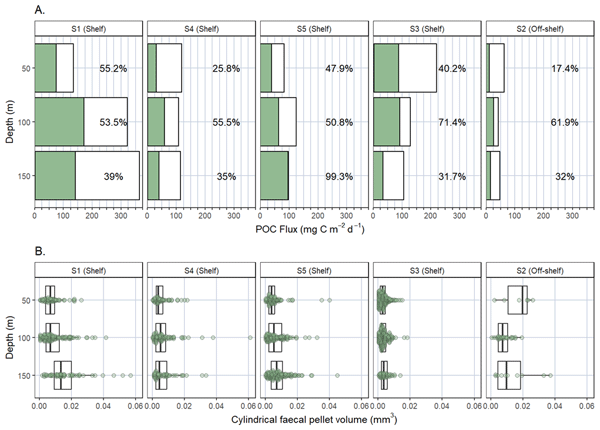
Krill defecation at depth reduces carbon flux attenuation in the Weddell Sea euphotic zone
Florence Sarah Atherden, Emily Rowlands, Gareth Flint, Sophie Fielding, Katrin Schmidt, Elaine Fileman, Angus Atkinson, and Clara Manno
EGUsphere, https://doi.org/10.5194/egusphere-2026-988,https://doi.org/10.5194/egusphere-2026-988, 2026
Preprint under review for OS (discussion: open, 0 comments)
Short summary
CC BY 4.0