
Articles | Volume 21, issue 6
https://doi.org/10.5194/os-21-2849-2025
© Author(s) 2025. This work is distributed under
the Creative Commons Attribution 4.0 License.
the Creative Commons Attribution 4.0 License.
https://doi.org/10.5194/os-21-2849-2025
© Author(s) 2025. This work is distributed under
the Creative Commons Attribution 4.0 License.
the Creative Commons Attribution 4.0 License.
Research article
| 
11 Nov 2025
Research article |
| 11 Nov 2025
| 11 Nov 2025
When storms stir the Mediterranean depths: chlorophyll a response to Mediterranean cyclones
Giovanni Scardino
CORRESPONDING AUTHOR

Department of Earth and Geoenvironmental Sciences, University of Bari Aldo Moro, 70125 Bari, Italy
Interdepartmental Research Centre for Coastal Dynamics, University of Bari Aldo Moro, 70125 Bari, Italy
Alok Kushabaha
Department of Earth and Geoenvironmental Sciences, University of Bari Aldo Moro, 70125 Bari, Italy
IUSS – School for Advanced Studies, Pavia, Italy
Mario Marcello Miglietta
Institute of Atmospheric Sciences and Climate (CNR-ISAC), National Research Council of Italy, Padua, Italy
Davide Bonaldo
Institute of Marine Sciences (CNR-ISMAR), National Research Council of Italy, Venice, Italy
Giovanni Scicchitano
Department of Earth and Geoenvironmental Sciences, University of Bari Aldo Moro, 70125 Bari, Italy
Interdepartmental Research Centre for Coastal Dynamics, University of Bari Aldo Moro, 70125 Bari, Italy
Related authors
Patrick Boyden, Donghao Li, Sonia Bejarano, Benjamin Mueller, Christian Wild, Eric Mijts, Giovanni Scicchitano, Giovanni Scardino, Denovan Chauveau, Ute Merkel, Yusuf C. El-Khaled, Paolo Stocchi, Mark Vermeij, and Alessio Rovere
EGUsphere, https://doi.org/10.31223/X58Q9J, https://doi.org/10.31223/X58Q9J, 2026
This preprint is open for discussion and under review for Climate of the Past (CP).
Short summary
Short summary
Exposed fossil reefs from Aruba, Bonaire, and Curaçao reveal that during the Last Interglacial (~125,000 years ago), reefs thrived on both windward and leeward coasts. However today, living reefs are mostly confined to the sheltered leeward coasts. We tie this dichotomy to weaker trade winds and calmer seas in the southern Caribbean at the onset of the Last Interglacial. This contrast highlights how changing ocean and wind patterns have substantially shaped reef resilience through time.
Patrick Boyden, Donghao Li, Sonia Bejarano, Benjamin Mueller, Christian Wild, Eric Mijts, Giovanni Scicchitano, Giovanni Scardino, Denovan Chauveau, Ute Merkel, Yusuf C. El-Khaled, Paolo Stocchi, Mark Vermeij, and Alessio Rovere
EGUsphere, https://doi.org/10.31223/X58Q9J, https://doi.org/10.31223/X58Q9J, 2026
This preprint is open for discussion and under review for Climate of the Past (CP).
Short summary
Short summary
Exposed fossil reefs from Aruba, Bonaire, and Curaçao reveal that during the Last Interglacial (~125,000 years ago), reefs thrived on both windward and leeward coasts. However today, living reefs are mostly confined to the sheltered leeward coasts. We tie this dichotomy to weaker trade winds and calmer seas in the southern Caribbean at the onset of the Last Interglacial. This contrast highlights how changing ocean and wind patterns have substantially shaped reef resilience through time.
Davide Bonaldo, Sandro Carniel, Renato R. Colucci, Cléa Denamiel, Petra Pranić, Fabio Raicich, Antonio Ricchi, Lorenzo Sangelantoni, Ivica Vilibić, and Maria Letizia Vitelletti
Ocean Sci., 21, 1003–1031, https://doi.org/10.5194/os-21-1003-2025, https://doi.org/10.5194/os-21-1003-2025, 2025
Short summary
Short summary
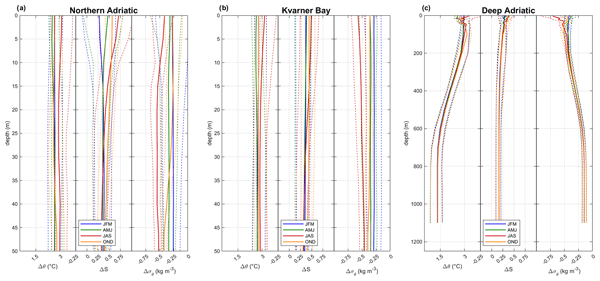
We present a high-resolution modelling effort to investigate the possible end-of-century evolution of the main physical processes in the Adriatic Sea in a severe climate change scenario, with an ensemble approach (i.e. use of multiple simulations) allowing us to control the uncertainty of the predictions. Our model exhibits a satisfactory capability to reproduce the recent past and provides a basis for a set of multidisciplinary studies in this area over a multi-decadal horizon.
Peter Mlakar, Antonio Ricchi, Sandro Carniel, Davide Bonaldo, and Matjaž Ličer
Geosci. Model Dev., 17, 4705–4725, https://doi.org/10.5194/gmd-17-4705-2024, https://doi.org/10.5194/gmd-17-4705-2024, 2024
Short summary
Short summary
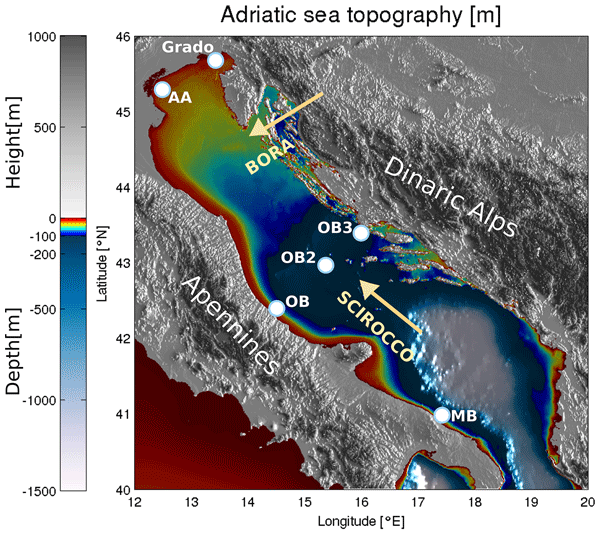
We propose a new point-prediction model, the DEep Learning WAVe Emulating model (DELWAVE), which successfully emulates the Simulating WAves Nearshore model (SWAN) over synoptic to climate timescales. Compared to control climatology over all wind directions, the mismatch between DELWAVE and SWAN is generally small compared to the difference between scenario and control conditions, suggesting that the noise introduced by surrogate modelling is substantially weaker than the climate change signal.
Alfio Marco Borzì, Vittorio Minio, Raphael De Plaen, Thomas Lecocq, Salvatore Alparone, Salvatore Aronica, Flavio Cannavò, Fulvio Capodici, Giuseppe Ciraolo, Sebastiano D'Amico, Danilo Contrafatto, Giuseppe Di Grazia, Ignazio Fontana, Giovanni Giacalone, Graziano Larocca, Carlo Lo Re, Giorgio Manno, Gabriele Nardone, Arianna Orasi, Marco Picone, Giovanni Scicchitano, and Andrea Cannata
Ocean Sci., 20, 1–20, https://doi.org/10.5194/os-20-1-2024, https://doi.org/10.5194/os-20-1-2024, 2024
Short summary
Short summary
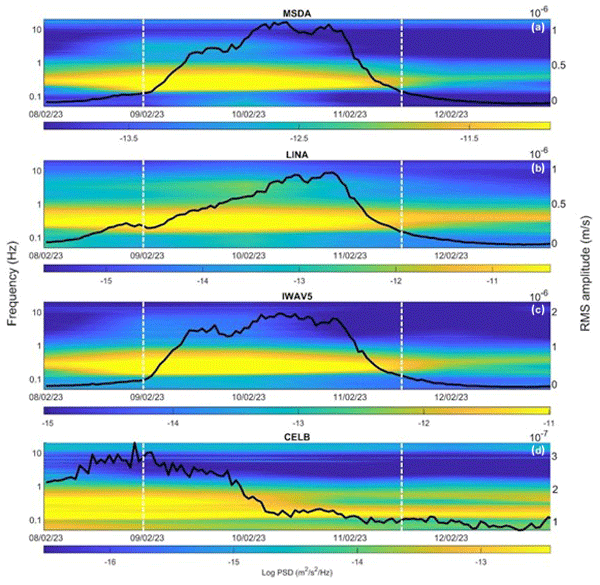
In this work, we study a Mediterranean cyclone that occurred in February 2023 and its relationship with a particular seismic signal called microseism. By integrating the data recorded by seismic stations, satellites, HF radar and wavemeter buoy we are able to obtain information about this event. We show how an innovative monitoring system of the Mediterranean cyclones can be designed by integrating microseism information with other techniques routinely used to study meteorological phenomena.
Cited articles
Androulidakis, Y. and Pytharoulis, I.: Variability of marine heatwaves and atmospheric cyclones in the Mediterranean Sea during the last four decades, Environ. Res. Lett., 20, 034031, https://doi.org/10.1088/1748-9326/adb505, 2025.
Argo: Argo float data and metadata from the Global Data Assembly Centre (GDAC), SEANOE [data set], https://doi.org/10.17882/42182, 2023.
Argüeso, D., Marcos, M., and Amores, A.: Storm Daniel fueled by anomalously high sea surface temperatures in the Mediterranean, npj Clim. Atmos. Sci., 7, 1–12, https://doi.org/10.1038/s41612-024-00872-2, 2024.
Athanasiou, P., van Dongeren, A., Giardino, A., Vousdoukas, M., Gaytan-Aguilar, S., and Ranasinghe, R.: Global distribution of nearshore slopes with implications for coastal retreat, Earth Syst. Sci. Data, 11, 1515–1529, https://doi.org/10.5194/essd-11-1515-2019, 2019.
Avolio, E., Fanelli, C., Pisano, A., and Miglietta, M. M.: Unveiling the Relationship Between Mediterranean Tropical-Like Cyclones and Rising Sea Surface Temperature, Geophys. Res. Lett., 51, e2024GL109921, https://doi.org/10.1029/2024GL109921, 2024.
Barboni, A., Coadou-Chaventon, S., Stegner, A., Le Vu, B., and Dumas, F.: How subsurface and double-core anticyclones intensify the winter mixed-layer deepening in the Mediterranean Sea, Ocean Sci., 19, 229–250, https://doi.org/10.5194/os-19-229-2023, 2023.
Belkin, I. M.: Rapid warming of Large Marine Ecosystems, Prog. Oceanogr., 81, 207–213, https://doi.org/10.1016/j.pocean.2009.04.011, 2009.
Carrió, D. S.: Improving the predictability of the Qendresa Medicane by the assimilation of conventional and atmospheric motion vector observations. Storm-scale analysis and short-range forecast, Nat. Hazards Earth Syst. Sci., 23, 847–869, https://doi.org/10.5194/nhess-23-847-2023, 2023.
Cavicchia, L., von Storch, H., and Gualdi, S.: Mediterranean Tropical-Like Cyclones in Present and Future Climate, J. Climate, 27, 7493–7501, https://doi.org/10.1175/JCLI-D-14-00339.1, 2014.
Chai, F., Wang, Y., Xing, X., Yan, Y., Xue, H., Wells, M., and Boss, E.: A limited effect of sub-tropical typhoons on phytoplankton dynamics, Biogeosciences, 18, 849–859, https://doi.org/10.5194/bg-18-849-2021, 2021.
Chen, D., He, L., Liu, F., and Yin, K.: Effects of typhoon events on chlorophyll and carbon fixation in different regions of the East China Sea, Estuar. Coast. Shelf Sci., 194, 229–239, https://doi.org/10.1016/j.ecss.2017.06.026, 2017.
Clementi, E., Pistoia, Escudier, R., Delrosso, D., Drudi, M., Grandi, A., Lecci, R., Cretí, S., Ciliberti, S., Coppini, G., Masina, S., and Pinardi, N.: Mediterranean Sea Physical Analysis and Forecast (CMEMS MED-Currents 2016–2019), CMEMS – Copernicus Monitoring Environment Marine Service [data set], https://doi.org/10.25423/cmcc/medsea_analysis_forecast_phy, 2019.
Comellas Prat, A., Federico, S., Torcasio, R. C., D'Adderio, L. P., Dietrich, S., and Panegrossi, G.: Evaluation of the Sensitivity of Medicane Ianos to Model Microphysics and Initial Conditions Using Satellite Measurements, Remote Sens., 13, 4984, https://doi.org/10.3390/rs13244984, 2021.
Cossarini, G., Feudale, L., Teruzzi, A., Bolzon, G., Coidessa, G., Solidoro, C., Di Biagio, V., Amadio, C., Lazzari, P., Brosich, A., and Salon, S.: High-Resolution Reanalysis of the Mediterranean Sea Biogeochemistry (1999–2019), Front. Mar. Sci., 8, https://doi.org/10.3389/fmars.2021.741486, 2021.
Cullen, J. J.: Subsurface chlorophyll maximum layers: enduring enigma or mystery solved?, Ann. Rev. Mar. Sci., 7, 207–239, https://doi.org/10.1146/annurev-marine-010213-135111, 2015.
D'Adderio, L. P., Casella, D., Dietrich, S., Sanò, P., and Panegrossi, G.: GPM-CO observations of Medicane Ianos: Comparative analysis of precipitation structure between development and mature phase, Atmos. Res., 273, 106174, https://doi.org/10.1016/j.atmosres.2022.106174, 2022.
D'Adderio, L. P., Panegrossi, G., Dafis, S., Rysman, J.-F., Casella, D., Sanò, P., Fuccello, A., and Miglietta, M. M.: Helios and Juliette: Two Falsely Acclaimed Medicanes, SSRN, https://doi.org/10.2139/ssrn.4542818, 2023.
Dafis, S., Claud, C., Kotroni, V., Lagouvardos, K., and Rysman, J.-F.: Insights into the convective evolution of Mediterranean tropical-like cyclones, Q. J. Roy. Meteorol. Soc., 146, 4147–4169, https://doi.org/10.1002/qj.3896, 2020.
Darmaraki, S., Somot, S., Sevault, F., Nabat, P., Cabos Narvaez, W. D., Cavicchia, L., Djurdjevic, V., Li, L., Sannino, G., and Sein, D. V.: Future evolution of Marine Heatwaves in the Mediterranean Sea, Clim. Dynam., 53, 1371–1392, https://doi.org/10.1007/s00382-019-04661-z, 2019.
Davolio, S., Fera, S. D., Laviola, S., Miglietta, M. M., and Levizzani, V.: Heavy Precipitation over Italy from the Mediterranean Storm “Vaia” in October 2018: Assessing the Role of an Atmospheric River, Mon. Weather Rev., 148, 3571–3588, https://doi.org/10.1175/MWR-D-20-0021.1, 2020.
de la Vara, A., Gutiérrez-Fernández, J., González-Alemán, J. J., and Gaertner, M. Á.: Characterization of medicanes with a minimal number of geopotential levels, Int. J. Climatol., 41, 3300–3316, https://doi.org/10.1002/joc.7020, 2021.
Di Francesca, V., D'Adderio, L. P., Sanò, P., Rysman, J.-F., Casella, D., and Panegrossi, G.: Passive microwave-based diagnostics of medicanes over the period 2000–2021, Atmos. Res., 316, 107922, https://doi.org/10.1016/j.atmosres.2025.107922, 2025.
Di Muzio, E., Riemer, M., Fink, A. H., and Maier-Gerber, M.: Assessing the predictability of Medicanes in ECMWF ensemble forecasts using an object-based approach, Q. J. Roy. Meteorol. Soc., 145, 1202–1217, https://doi.org/10.1002/qj.3489, 2019.
D'Ortenzio, F. and Ribera d'Alcalà, M.: On the trophic regimes of the Mediterranean Sea: a satellite analysis, Biogeosciences, 6, 139–148, https://doi.org/10.5194/bg-6-139-2009, 2009.
D'Ortenzio, F., Iudicone, D., de Boyer Montegut, C., Testor, P., Antoine, D., Marullo, S., Santoleri, R., and Madec, G.: Seasonal variability of the mixed layer depth in the Mediterranean Sea as derived from in situ profiles, Geophys. Res. Lett., 32, https://doi.org/10.1029/2005GL022463, 2005.
Escudier, R., Clementi, E., Omar, M., Cipollone, A., Pistoia, J., Aydogdu, A., Drudi, M., Grandi, A., Lyubartsev, V., Lecci, R., Cretí, S., Masina, S., Coppini, G., and Pinardi, N.: Mediterranean Sea Physical Reanalysis (CMEMS MED-Currents) (Version 1) Data set, CMEMS – Copernicus Monitoring Environment Marine Service [data set], https://doi.org/10.25423/CMCC/MEDSEA_MULTIYEAR_PHY, 2020.
Federico, S., Comellas Prat, A., Torcasio, R. C., D'Adderio, L. P., Dietrich, S., and Panegrossi, G.: Medicane Ianos: a comparative study between WRF model and satellite measurements, EMS Annual Meeting 2021, online, 6–10 Sep 2021, EMS2021-297, https://doi.org/10.5194/ems2021-297, 2021.
Fita, L., Romero, R., Luque, A., Emanuel, K., and Ramis, C.: Analysis of the environments of seven Mediterranean tropical-like storms using an axisymmetric, nonhydrostatic, cloud resolving model, Nat. Hazards Earth Syst. Sci., 7, 41–56, https://doi.org/10.5194/nhess-7-41-2007, 2007.
Flaounas, E., Davolio, S., Raveh-Rubin, S., Pantillon, F., Miglietta, M. M., Gaertner, M. A., Hatzaki, M., Homar, V., Khodayar, S., Korres, G., Kotroni, V., Kushta, J., Reale, M., and Ricard, D.: Mediterranean cyclones: current knowledge and open questions on dynamics, prediction, climatology and impacts, Weather Clim. Dynam., 3, 173–208, https://doi.org/10.5194/wcd-3-173-2022, 2022.
Flaounas, E., Aragão, L., Bernini, L., Dafis, S., Doiteau, B., Flocas, H., Gray, S. L., Karwat, A., Kouroutzoglou, J., Lionello, P., Miglietta, M. M., Pantillon, F., Pasquero, C., Patlakas, P., Picornell, M. Á., Porcù, F., Priestley, M. D. K., Reale, M., Roberts, M. J., Saaroni, H., Sandler, D., Scoccimarro, E., Sprenger, M., and Ziv, B.: A composite approach to produce reference datasets for extratropical cyclone tracks: application to Mediterranean cyclones, Weather Clim. Dynam., 4, 639–661, https://doi.org/10.5194/wcd-4-639-2023, 2023.
Flaounas, E., Dafis, S., Davolio, S., Faranda, D., Ferrarin, C., Hartmuth, K., Hochman, A., Koutroulis, A., Khodayar, S., Miglietta, M. M., Pantillon, F., Patlakas, P., Sprenger, M., and Thurnherr, I.: Dynamics, predictability, impacts, and climate change considerations of the catastrophic Mediterranean Storm Daniel (2023), EGUsphere [preprint], https://doi.org/10.5194/egusphere-2024-2809, 2024.
Fu, H., Wang, X., Chu, P. C., Zhang, X., Han, G., and Li, W.: Tropical cyclone footprint in the ocean mixed layer observed by Argo in the Northwest Pacific, J. Geophys. Res.-Oceans, 119, 8078–8092, https://doi.org/10.1002/2014JC010316, 2014.
Gallisai, R., Volpe, G., and Peters, F.: Large Saharan dust storms: Implications for chlorophyll dynamics in the Mediterranean Sea, Global Biogeochem. Cy., 30, 1725–1737, https://doi.org/10.1002/2016GB005404, 2016.
GEBCO: The General Bathymetric Chart of the Oceans, https://www.gebco.net/ (last access: 15 April 2020), 2020.
Geisler, J. E.: Linear theory of the response of a two layer ocean to a moving hurricane, Geophys. Fluid Dynam., 1, 249–272, https://doi.org/10.1080/03091927009365774, 1970.
Giovannini, L., Davolio, S., Zaramella, M., Zardi, D., and Borga, M.: Multi-model convection-resolving simulations of the October 2018 Vaia storm over Northeastern Italy, Atmos. Res., 253, 105455, https://doi.org/10.1016/j.atmosres.2021.105455, 2021.
González-Alemán, J. J., Pascale, S., Gutierrez-Fernandez, J., Murakami, H., Gaertner, M. A., and Vecchi, G. A.: Potential Increase in Hazard From Mediterranean Hurricane Activity With Global Warming, Geophys. Res. Lett., 46, 1754–1764, https://doi.org/10.1029/2018GL081253, 2019.
Gutiérrez-Fernández, J., Miglietta, M. M., González-Alemán, J. J., and Gaertner, M. A.: A New Refinement of Mediterranean Tropical-Like Cyclones Characteristics, Geophys. Res. Lett., 51, e2023GL106429, https://doi.org/10.1029/2023GL106429, 2024.
Izquierdo, P., Taboada, F. G., González-Gil, R., Arrontes, J., and Rico, J. M.: Alongshore upwelling modulates the intensity of marine heatwaves in a temperate coastal sea, Sci. Total Environ., 835, 155478, https://doi.org/10.1016/j.scitotenv.2022.155478, 2022.
Jangir, B., Mishra, A. K., and Strobach, E.: Effects of Mesoscale Eddies on the Intensity of Cyclones in the Mediterranean Sea, J. Geophys. Res.-Atmos., 128, e2023JD038607, https://doi.org/10.1029/2023JD038607, 2023.
Jangir, B., Mishra, A. K., and Strobach, E.: The interplay between medicanes and the Mediterranean Sea in the presence of sea surface temperature anomalies, Atmos. Res., 310, 107625, https://doi.org/10.1016/j.atmosres.2024.107625, 2024.
Karagiorgos, J., Samos, I., Vervatis, V., Sofianos, S., and Flocas, H.: The Impact of Ocean–Atmosphere Coupling on the Prediction of Mediterranean Cyclones: A Case Study of Medicane Ianos, Environ. Sci. Proceed., 26, 60, https://doi.org/10.3390/environsciproc2023026060, 2023.
Kassis, D. and Varlas, G.: Hydrographic effects of an intense “medicane” over the central-eastern Mediterranean Sea in 2018, Dynam. Atmos. Oceans, 93, 101185, https://doi.org/10.1016/j.dynatmoce.2020.101185, 2021.
Katara, I., Illian, J., Pierce, G., Scott, B., and Wang, J.: Atmospheric forcing on chlorophyll concentration in the Mediterranean, Hydrobiologia, 612, 33–48, https://doi.org/10.1007/s10750-008-9492-z, 2008.
Kotta, D.: Extreme Weather Affecting Sea Chlorophyll: The Case of a Medicane, Environ. Sci. Proceed., 26, 192, https://doi.org/10.3390/environsciproc2023026192, 2023.
Kotta, D. and Kitsiou, D.: Chlorophyll in the Eastern Mediterranean Sea: Correlations with Environmental Factors and Trends, Environments, 6, 98, https://doi.org/10.3390/environments6080098, 2019a.
Kotta, D. and Kitsiou, D.: Medicanes Triggering Chlorophyll Increase, J. Mar. Sci. Eng., 7, 75, https://doi.org/10.3390/jmse7030075, 2019b.
Kotta, D., Kitsiou, D., and Kassomenos, P.: First Rains as Extreme Events Influencing Marine Primary Production, Springer, 263–270, https://doi.org/10.1007/978-3-319-35095-0_37, 2017.
Kushabaha, A., Scardino, G., Sabato, G., Miglietta, M. M., Flaounas, E., Monforte, P., Marsico, A., De Santis, V., Borzì, A. M., and Scicchitano, G.: ARCHIMEDE – An Innovative Web-GIS Platform for the Study of Medicanes, Remote Sens., 16, 2552, https://doi.org/10.3390/rs16142552, 2024.
Lagouvardos, K., Karagiannidis, A., Dafis, S., Kalimeris, A., and Kotroni, V.: Ianos – A Hurricane in the Mediterranean, B. Am. Meteorol. Soc., 103, E1621–E1636, https://doi.org/10.1175/BAMS-D-20-0274.1, 2022.
Latha, T. P., Rao, K. H., Nagamani, P. V., Amminedu, E., Choudhury, S. B., Dutt, C. B. S., and Dadhwal, V. K.: Impact of Cyclone PHAILIN on Chlorophyll-a Concentration and Productivity in the Bay of Bengal, Int. J. Geosci., 6, 473–480, https://doi.org/10.4236/ijg.2015.65037, 2015.
Lazzari, P., Solidoro, C., Salon, S., and Bolzon, G.: Spatial variability of phosphate and nitrate in the Mediterranean Sea: A modeling approach, Deep-Sea Res. Pt. I, 108, 39–52, https://doi.org/10.1016/j.dsr.2015.12.006, 2016.
Li, M., Organelli, E., Serva, F., Bellacicco, M., Landolfi, A., Pisano, A., Marullo, S., Shen, F., Mignot, A., van Gennip, S., and Santoleri, R.: Phytoplankton Spring Bloom Inhibited by Marine Heatwaves in the North-Western Mediterranean Sea, Geophys. Res. Lett., 51, e2024GL109141, https://doi.org/10.1029/2024GL109141, 2024a.
Li, X., Zheng, H., Mao, Z., Du, P., and Zhang, W.: Change in water column total chlorophyll a in the Mediterranean revealed by satellite observation, Sci. Total Environ., 945, 174076, https://doi.org/10.1016/j.scitotenv.2024.174076, 2024b.
Lin, I.-I.: Typhoon-induced phytoplankton blooms and primary productivity increase in the Western North Pacific Subtropical Ocean, J. Geophys. Res.-Oceans, 117, 3039, https://doi.org/10.1029/2011JC007626, 2012.
Listowski, C., Forestier, E., Dafis, S., Farges, T., De Carlo, M., Grimaldi, F., Le Pichon, A., Vergoz, J., Heinrich, P., and Claud, C.: Remote Monitoring of Mediterranean Hurricanes Using Infrasound, Remote Sens., 14, 6162, https://doi.org/10.3390/rs14236162, 2022.
Liu, X., Wei, J., Zhang, D.-L., and Miller, W.: Parameterizing Sea Surface Temperature Cooling Induced by Tropical Cyclones: 1. Theory and An Application to Typhoon Matsa (2005), J. Geophys. Res.-Oceans, 124, 1215–1231, https://doi.org/10.1029/2018JC014117, 2019.
Liu, Y., Tang, D., Tang, S., Morozov, E., Liang, W., and Sui, Y.: A case study of Chlorophyll a response to tropical cyclone Wind Pump considering Kuroshio invasion and air–sea heat exchange, Sci. Total Environ., 741, 140290, https://doi.org/10.1016/j.scitotenv.2020.140290, 2020.
Ludwig, W., Dumont, E., Meybeck, M., and Heussner, S.: River discharges of water and nutrients to the Mediterranean and Black Sea: Major drivers for ecosystem changes during past and future decades?, Prog. Oceanogr., 80, 199–217, https://doi.org/10.1016/j.pocean.2009.02.001, 2009.
Macías, D., Stips, A., and Garcia-Gorriz, E.: The relevance of deep chlorophyll maximum in the open Mediterranean Sea evaluated through 3D hydrodynamic-biogeochemical coupled simulations, Ecol. Model., 281, 26–37, https://doi.org/10.1016/j.ecolmodel.2014.03.002, 2014.
Marañón, E., Van Wambeke, F., Uitz, J., Boss, E. S., Dimier, C., Dinasquet, J., Engel, A., Haëntjens, N., Pérez-Lorenzo, M., Taillandier, V., and Zäncker, B.: Deep maxima of phytoplankton biomass, primary production and bacterial production in the Mediterranean Sea, Biogeosciences, 18, 1749–1767, https://doi.org/10.5194/bg-18-1749-2021, 2021.
Marra, A. C., Federico, S., Montopoli, M., Avolio, E., Baldini, L., Casella, D., D'Adderio, L. P., Dietrich, S., Sanò, P., Torcasio, R. C., and Panegrossi, G.: The Precipitation Structure of the Mediterranean Tropical-Like Cyclone Numa: Analysis of GPM Observations and Numerical Weather Prediction Model Simulations, Remote Sens., 11, 1690, https://doi.org/10.3390/rs11141690, 2019.
Marty, J.-C. and Chiavérini, J.: Seasonal and interannual variations in phytoplankton production at DYFAMED time-series station, northwestern Mediterranean Sea, Deep-Sea Res. Pt. II, 49, 2017–2030, https://doi.org/10.1016/S0967-0645(02)00025-5, 2002.
Marty, J. C. and Chiavérini, J.: Hydrological changes in the Ligurian Sea (NW Mediterranean, DYFAMED site) during 1995–2007 and biogeochemical consequences, Biogeosciences, 7, 2117–2128, https://doi.org/10.5194/bg-7-2117-2010, 2010.
Mei, W., Lien, C.-C., Lin, I.-I., and Xie, S.-P.: Tropical Cyclone-Induced Ocean Response: A Comparative Study of the South China Sea and Tropical Northwest Pacific, J. Climate, 28, 5952–5968, https://doi.org/10.1175/JCLI-D-14-00651.1, 2015.
Mélin, F., Vantrepotte, V., Chuprin, A., Grant, M., Jackson, T., and Sathyendranath, S.: Assessing the fitness-for-purpose of satellite multi-mission ocean color climate data records: A protocol applied to OC-CCI chlorophyll-a data, Remote Sens. Environ., 203, 139–151, https://doi.org/10.1016/j.rse.2017.03.039, 2017.
Menkes, C. E., Lengaigne, M., Lévy, M., Ethé, C., Bopp, L., Aumont, O., Vincent, E., Vialard, J., and Jullien, S.: Global impact of tropical cyclones on primary production, Global Biogeochem. Cy., 30, 767–786, https://doi.org/10.1002/2015GB005214, 2016.
Menna, M., Martellucci, R., Reale, M., Cossarini, G., Salon, S., Notarstefano, G., Mauri, E., Poulain, P.-M., Gallo, A., and Solidoro, C.: A case study of impacts of an extreme weather system on the Mediterranean Sea circulation features: Medicane Apollo (2021), Sci. Rep., 13, 3870, https://doi.org/10.1038/s41598-023-29942-w, 2023.
Miglietta, M. M.: Mediterranean Tropical-Like Cyclones (Medicanes), Atmosphere, 10, 206, https://doi.org/10.3390/atmos10040206, 2019.
Miglietta, M. M. and Rotunno, R.: Development mechanisms for Mediterranean tropical-like cyclones (medicanes), Q. J. Roy. Meteorol. Soc., 145, 1444–1460, https://doi.org/10.1002/qj.3503, 2019.
Miglietta, M. M., González-Alemán, J., Panegrossi, G., Gaertner, M., Pantillon, F., Pasquero, C., Schultz, D., D'Adderio, L. P., Dafis, S., Husson, L., Ricchi, A., Carrió, D. S., Davolio, S., Fita, L., Picornell, M. A., Pytharoulis, I., Raveh-Rubin, S., Scoccimarro, E., Bernini, L., Cavicchia, L., Conte, D., Ferretti, R., Flocas, H. A., Gutiérrez-Fernández, J., Hatzaki, M., Homar Santaner, V., Jansà, A., Patlakas, P., and Flaounas, E.: Defining Medicanes: Bridging the Knowledge Gap Between Tropical and Extratropical Cyclones in the Mediterranean, B. Am. Meteorol. Soc., E1955–E1971, https://doi.org/10.1175/BAMS-D-24-0289.1, 2025.
Mignot, A., D'Ortenzio, F., Taillandier, V., Cossarini, G., and Salon, S.: Quantifying Observational Errors in Biogeochemical-Argo Oxygen, Nitrate, and Chlorophyll a Concentrations, Geophys. Res. Lett., 46, 4330–4337, https://doi.org/10.1029/2018GL080541, 2019.
Mourre, B., Reyes, E., Lorente, P., Santana, A., Hernández-Lasheras, J., Hernández-Carrasco, I., García-Jove, M., and Zarokanellos, N. D.: Intense wind-driven coastal upwelling in the Balearic Islands in response to Storm Blas (November 2021), in: 7th edition of the Copernicus Ocean State Report (OSR7), edited by: von Schuckmann, K., Moreira, L., Le Traon, P.-Y., Grégoire, M., Marcos, M., Staneva, J., Brasseur, P., Garric, G., Lionello, P., Karstensen, J., and Neukermans, G., Copernicus Publications, State Planet, 1-osr7, 15, https://doi.org/10.5194/sp-1-osr7-15-2023, 2023.
Moutzouris-Sidiris, I. and Topouzelis, K.: Assessment of Chlorophyll-a concentration from Sentinel-3 satellite images at the Mediterranean Sea using CMEMS open source in situ data, Open Geosci., 13, 85–97, https://doi.org/10.1515/geo-2020-0204, 2021.
Normand, J. C. L. and Heggy, E.: Assessing flash flood erosion following storm Daniel in Libya, Nat. Commun., 15, 6493, https://doi.org/10.1038/s41467-024-49699-8, 2024.
Owen, L. E., Catto, J. L., Stephenson, D. B., and Dunstone, N. J.: Compound precipitation and wind extremes over Europe and their relationship to extratropical cyclones, Weather Clim. Ext., 33, 100342, https://doi.org/10.1016/j.wace.2021.100342, 2021.
Panegrossi, G., D'Adderio, L. P., Dafis, S., Rysman, J.-F., Casella, D., Dietrich, S., and Sanò, P.: Warm Core and Deep Convection in Medicanes: A Passive Microwave-Based Investigation, Remote Sens., 15, 2838, https://doi.org/10.3390/rs15112838, 2023.
Piontkovski, S. and Al-Hashmi, K.: Atmospheric cyclones and seasonal cycles of biological productivity of the ocean, Int. J. Environ. Stud., 71, https://doi.org/10.1080/00207233.2014.880997, 2014.
Price, J. F.: Upper Ocean Response to a Hurricane, J. Phys. Oceanogr., 11, 153–175, https://doi.org/10.1175/1520-0485(1981)011<0153:UORTAH>2.0.CO;2, 1981.
Pytharoulis, I.: Analysis of a Mediterranean tropical-like cyclone and its sensitivity to the sea surface temperatures, Atmos. Res., 208, 167–179, https://doi.org/10.1016/j.atmosres.2017.08.009, 2018.
Ricchi, A., Miglietta, M. M., Barbariol, F., Benetazzo, A., Bergamasco, A., Bonaldo, D., Cassardo, C., Falcieri, F. M., Modugno, G., Russo, A., Sclavo, M., and Carniel, S.: Sensitivity of a Mediterranean Tropical-Like Cyclone to Different Model Configurations and Coupling Strategies, Atmosphere, 8, 92, https://doi.org/10.3390/atmos8050092, 2017.
Ricchi, A., Miglietta, M. M., Bonaldo, D., Cioni, G., Rizza, U., and Carniel, S.: Multi-Physics Ensemble versus Atmosphere–Ocean Coupled Model Simulations for a Tropical-Like Cyclone in the Mediterranean Sea, Atmosphere, 10, 202, https://doi.org/10.3390/atmos10040202, 2019.
Ricchi, A., Bonaldo, D., Miglietta, M. M., and Carniel, S.: On the Ocean Mixed Layer influence on the genesis of Mediterranean Tropical-Like cyclones, EGU General Assembly 2020, Online, 4–8 May 2020, EGU2020-22001, https://doi.org/10.5194/egusphere-egu2020-22001, 2020.
Rixen, M., Beckers, J.-M., Levitus, S., Antonov, J., Boyer, T., Maillard, C., Fichaut, M., Balopoulos, E., Iona, S., Dooley, H., Garcia, M.-J., Manca, B., Giorgetti, A., Manzella, G., Mikhailov, N., Pinardi, N., and Zavatarelli, M.: The Western Mediterranean Deep Water: A proxy for climate change, Geophys. Res. Lett., 32, https://doi.org/10.1029/2005GL022702, 2005.
Sanford, T. B., Black, P. G., Haustein, J. R., Feeney, J. W., Forristall, G. Z., and Price, J. F.: Ocean Response to a Hurricane. Part I: Observations, J. Phys. Oceanogr., 17, 2065–2083, https://doi.org/10.1175/1520-0485(1987)017<2065:ORTAHP>2.0.CO;2, 1987.
Saraceni, M., Silvestri, L., Bechtold, P., and Bongioannini Cerlini, P.: Mediterranean tropical-like cyclone forecasts and analysis using the ECMWF ensemble forecasting system with physical parameterization perturbations, Atmos. Chem. Phys., 23, 13883–13909, https://doi.org/10.5194/acp-23-13883-2023, 2023.
Scardino, G., Miglietta, M. M., Kushabaha, A., Casella, E., Rovere, A., Besio, G., Borzì, A. M., Cannata, A., Mazza, G., Sabato, G., and Scicchitano, G.: Fingerprinting Mediterranean hurricanes using pre-event thermal drops in seawater temperature, Sci. Rep., 14, 8014, https://doi.org/10.1038/s41598-024-58335-w, 2024.
Scardino, G., Kushabaha, A., Miglietta, M. M., Bonaldo, D., and Scicchitano, G.: When Storms Stir the Mediterranean Depths: Chlorophyll-a Response to Mediterranean Cyclones, Zenodo [data set], https://doi.org/10.5281/zenodo.15912789, 2025.
Scicchitano, G., Scardino, G., Monaco, C., Piscitelli, A., Milella, M., De Giosa, F., and Mastronuzzi, G.: Comparing impact effects of common storms and Medicanes along the coast of south-eastern Sicily, Mar. Geol., 439, 106556, https://doi.org/10.1016/j.margeo.2021.106556, 2021.
Shay, L. K., Black, P. G., Mariano, A. J., Hawkins, J. D., and Elsberry, R. L.: Upper ocean response to Hurricane Gilbert, J. Geophys. Res.-Oceans, 97, 20227–20248, https://doi.org/10.1029/92JC01586, 1992.
Skliris, N., Sofianos, S., Gkanasos, A., Mantziafou, A., Vervatis, V., Axaopoulos, P., and Lascaratos, A.: Decadal scale variability of sea surface temperature in the Mediterranean Sea in relation to atmospheric variability, Ocean Dynam., 62, 13–30, https://doi.org/10.1007/s10236-011-0493-5, 2012.
Suzuki, S., Niino, H., and Kimura, R.: The mechanism of upper-oceanic vertical motions forced by a moving typhoon, Fluid Dynam. Res., 43, 025504, https://doi.org/10.1088/0169-5983/43/2/025504, 2011.
Tartaglione, N., Speranza, A., Dalan, F., Nanni, T., Brunetti, M., and Maugeri, M.: The mobility of Atlantic baric depressions leading to intense precipitation over Italy: a preliminary statistical analysis, Nat. Hazards Earth Syst. Sci., 6, 451–458, https://doi.org/10.5194/nhess-6-451-2006, 2006.
Teruzzi, A., Bolzon, G., Feudale, L., and Cossarini, G.: Deep chlorophyll maximum and nutricline in the Mediterranean Sea: emerging properties from a multi-platform assimilated biogeochemical model experiment, Biogeosciences, 18, 6147–6166, https://doi.org/10.5194/bg-18-6147-2021, 2021.
Tiesi, A., Pucillo, A., Bonaldo, D., Ricchi, A., Carniel, S., and Miglietta, M. M.: Initialization of WRF Model Simulations With Sentinel-1 Wind Speed for Severe Weather Events, Front. Mar. Sci., 8, https://doi.org/10.3389/fmars.2021.573489, 2021.
Vargas-Yáñez, M., Moya, F., Balbín, R., Santiago, R., Ballesteros, E., Sánchez-Leal, R. F., Romero, P., and García-Martínez, M. C.: Seasonal and Long-Term Variability of the Mixed Layer Depth and its Influence on Ocean Productivity in the Spanish Gulf of Cádiz and Mediterranean Sea, Front. Mar. Sci., 9, 901893, https://doi.org/10.3389/fmars.2022.901893, 2022.
Varlas, G., Vervatis, V., Spyrou, C., Papadopoulou, E., Papadopoulos, A., and Katsafados, P.: Investigating the impact of atmosphere–wave–ocean interactions on a Mediterranean tropical-like cyclone, Ocean Modell., 153, 101675, https://doi.org/10.1016/j.ocemod.2020.101675, 2020.
Walker, N. D., Leben, R. R., and Balasubramanian, S.: Hurricane-forced upwelling and chlorophyll a enhancement within cold-core cyclones in the Gulf of Mexico, Geophys. Res. Lett., 32, https://doi.org/10.1029/2005GL023716, 2005.
Wang, Y.: Composite of Typhoon-Induced Sea Surface Temperature and Chlorophyll-a Responses in the South China Sea, J. Geophys. Res.-Oceans, 125, e2020JC016243, https://doi.org/10.1029/2020JC016243, 2020.
Wu, Y., Platt, T., Tang, C., and Sathyendranath, S.: Short-term changes in chlorophyll distribution in response to a moving storm: A modelling study, Mar. Ecol.-Prog. Ser., 335, 57–68, https://doi.org/10.3354/meps335057, 2007.
Yang, C.-Y., Yang, Y. J., Tseng, Y.-H., Jan, S., Chang, M.-H., Wei, C.-L., and Terng, C.-T.: Observational evidence of overlooked downwelling induced by tropical cyclones in the open ocean, Sci. Rep., 14, 335, https://doi.org/10.1038/s41598-023-51016-0, 2024.
Zhang, H., He, H., Zhang, W.-Z., and Tian, D.: Upper ocean response to tropical cyclones: a review, Geosci. Lett., 8, 1, https://doi.org/10.1186/s40562-020-00170-8, 2021.
Zhao, H., Tang, D., and Wang, Y.: Comparison of phytoplankton blooms triggered by two typhoons with different intensities and translation speeds in the South China Sea, Mar. Ecol.-Prog. Ser., 365, 57–65, https://doi.org/10.3354/meps07488, 2008.
Short summary
This study investigated how Mediterranean cyclones impact chlorophyll-a dynamics. Using reanalysis data, ARGO floats, and satellite imagery, we found that slow-moving cyclones significantly uplift the deep chlorophyll maximum. Upwelling and air-sea heat exchange were key mechanisms driving this uplift, enhancing nutrient availability and primary productivity. These findings highlight the strong influence of cyclone intensity and movement on biogeochemical processes in the Mediterranean Sea.
This study investigated how Mediterranean cyclones impact chlorophyll-a dynamics. Using...


