
Articles | Volume 22, issue 1
https://doi.org/10.5194/os-22-31-2026
© Author(s) 2026. This work is distributed under
the Creative Commons Attribution 4.0 License.
the Creative Commons Attribution 4.0 License.
https://doi.org/10.5194/os-22-31-2026
© Author(s) 2026. This work is distributed under
the Creative Commons Attribution 4.0 License.
the Creative Commons Attribution 4.0 License.
Research article
| 
05 Jan 2026
Research article |
| 05 Jan 2026
| 05 Jan 2026
Internal tides on the Al-Batinah shelf: evolution, structure and predictability
Gerd A. Bruss
CORRESPONDING AUTHOR

Sultan Qaboos University, Muscat, Oman
Estel Font
University of Gothenburg, Gothenburg, Sweden
Bastien Y. Queste
University of Gothenburg, Gothenburg, Sweden
Rob A. Hall
University of East Anglia, Norwich, United Kingdom
Scottish Association for Marine Science, Oban, United Kingdom
Related authors
Ahmed Abdelmaksoud, Aisha H. Al-Suwaidi, Gerd Bruss, Kaveh Samimi-Namin, and Mohammed Y. Ali
EGUsphere, https://doi.org/10.5194/egusphere-2026-1925, https://doi.org/10.5194/egusphere-2026-1925, 2026
Short summary
Short summary
The Persian/Arabian Gulf exports a dense, salty, oxygen-rich current that helps ventilate the Arabian Sea. Measurements along the northern margin of the Gulf of Oman show that the flow remains thin and attached over smooth seafloor, but thickens, mixes, and detaches over the rough terrain of the shelf. These changes affect oxygen delivery and benthic life, and also suggest that climate-driven density shifts may alter their pathways and impacts.
Ahmed Abdelmaksoud, Aisha H. Al-Suwaidi, Gerd Bruss, Kaveh Samimi-Namin, and Mohammed Y. Ali
EGUsphere, https://doi.org/10.5194/egusphere-2026-1925, https://doi.org/10.5194/egusphere-2026-1925, 2026
Short summary
Short summary
The Persian/Arabian Gulf exports a dense, salty, oxygen-rich current that helps ventilate the Arabian Sea. Measurements along the northern margin of the Gulf of Oman show that the flow remains thin and attached over smooth seafloor, but thickens, mixes, and detaches over the rough terrain of the shelf. These changes affect oxygen delivery and benthic life, and also suggest that climate-driven density shifts may alter their pathways and impacts.
Estel Font, Esther Portela, Sebastiaan Swart, Mauro Pinto-Juica, and Bastien Y. Queste
Ocean Sci., 22, 387–401, https://doi.org/10.5194/os-22-387-2026, https://doi.org/10.5194/os-22-387-2026, 2026
Short summary
Short summary
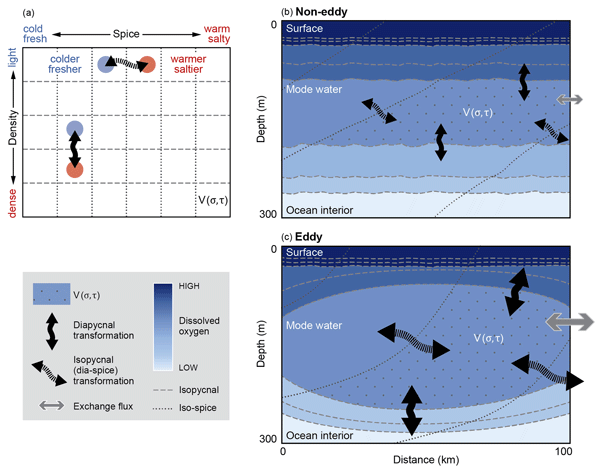
In the Sea of Oman, mode waters form at the surface in winter and are trapped beneath a warmer surface layer in spring, linking the surface ocean and the oxygen minimum zone. Using data from ocean gliders, our study examines how this layer evolves. Changes occur along layers of equal density, with brief episodes of vertical mixing, enhanced by eddies. Glider data reveal more variability than monthly means, showing the need for sustained glider observations to understand future ecosystem impacts.
Tom A. Jordan, Karen J. Heywood, Anna Wåhlin, Rob A. Hall, Atsuhiro Muto, Pierre Dutrieux, Kelly Hogan, James Girton, Karen E. Alley, and Erin Pettit
EGUsphere, https://doi.org/10.5194/egusphere-2025-6001, https://doi.org/10.5194/egusphere-2025-6001, 2026
Short summary
Short summary
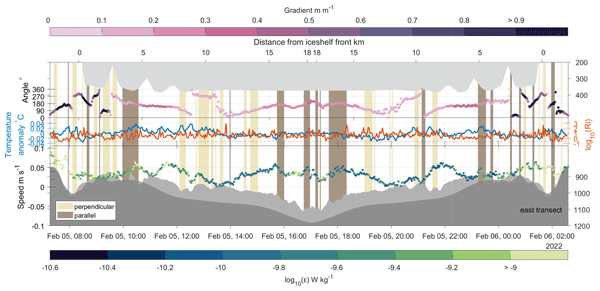
The shape of the water filled cavity hidden beneath ice shelves is extremely important, but hard to measure. Gravity data collected from aircraft can be used to predict the shape. However, in the Dotson Crosson ice shelves in West Antarctica, new direct observations from autonomous platforms sent beneath the ice, and seismic observations from the ice surface showed gravity models were systematically too shallow. We explain why and provide a solution applicable her and in other ice shelves.
Maren Elisabeth Richter, Karen J. Heywood, Rob A. Hall, and Peter E. D. Davis
Ocean Sci., 21, 3341–3359, https://doi.org/10.5194/os-21-3341-2025, https://doi.org/10.5194/os-21-3341-2025, 2025
Short summary
Short summary
Warm ocean water causes rapid melting of Antarctic glaciers. The circulation and mixing of warm water in ice shelf cavities is mostly unknown. We observed ocean currents and mixing under Dotson Ice Shelf. Mixing is low, with patches of higher mixing associated with stronger currents and vertical current shear. The levels of turbulent mixing will lead to negligible heat loss during the path of the warm water to the grounding line, leaving plenty of heat available to melt the ice shelf there.
Daisy D. Pickup, Dorothee C. E. Bakker, Karen J. Heywood, Francis Glassup, Emily M. Hammermeister, Sharon E. Stammerjohn, Gareth A. Lee, Socratis Loucaides, Bastien Y. Queste, Benjamin G. M. Webber, and Patricia L. Yager
Ocean Sci., 21, 2727–2741, https://doi.org/10.5194/os-21-2727-2025, https://doi.org/10.5194/os-21-2727-2025, 2025
Short summary
Short summary
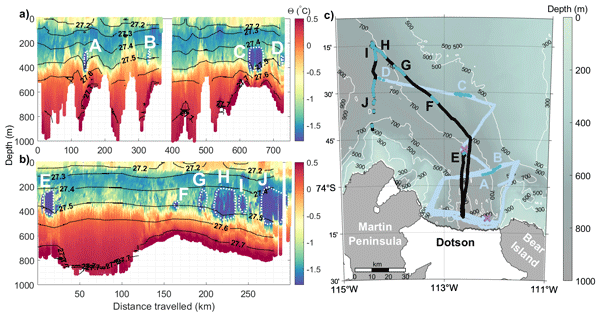
Autonomous platforms in the Amundsen Sea have allowed for detection of isolated water masses that are colder, saltier and denser than overlying water. They are also associated with a higher dissolved inorganic carbon concentration and lower pH. The water masses, referred to as lenses, could have implications for the transfer of heat and storage of carbon in the region. We hypothesise that they form in surrounding areas that experience intense cooling and sea ice formation in autumn/winter.
Peter M. F. Sheehan, Benjamin G. M. Webber, Alejandra Sanchez-Franks, and Bastien Y. Queste
Ocean Sci., 21, 1575–1588, https://doi.org/10.5194/os-21-1575-2025, https://doi.org/10.5194/os-21-1575-2025, 2025
Short summary
Short summary
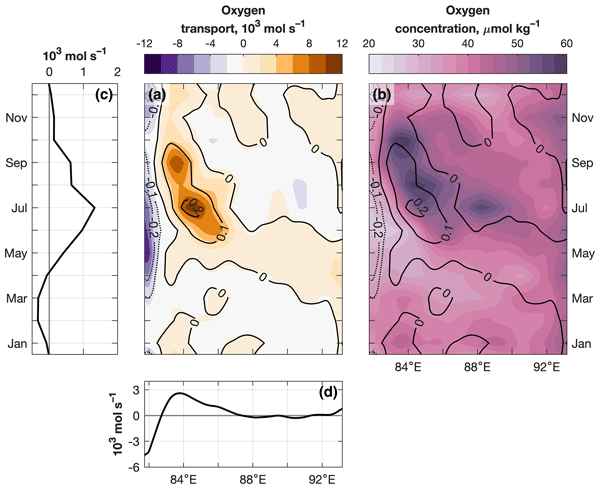
Using measurements and computer models, we identify a large flux of oxygen within the Southwest Monsoon Current, which flows north into the Bay of Bengal between June and September each year. Oxygen levels in the bay are very low, but they are not quite low enough for key nutrient cycles to be as dramatically altered as in other low-oxygen regions. We suggest that the flux which we identify contributes to keeping oxygen levels in the bay above the threshold below which dramatic changes would occur.
Estel Font, Sebastiaan Swart, Puthenveettil Narayana Vinayachandran, and Bastien Y. Queste
Ocean Sci., 21, 1349–1368, https://doi.org/10.5194/os-21-1349-2025, https://doi.org/10.5194/os-21-1349-2025, 2025
Short summary
Short summary
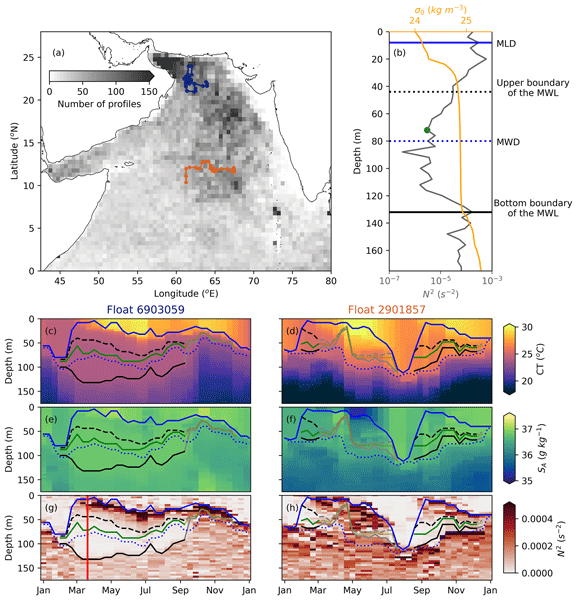
Mode water is formed annually and sits between the warm surface water and deeper older waters. In the Arabian Sea, it plays a crucial role in regulating ocean heat and oxygen variability by acting as a doorway between the surface and deeper waters. Using observations and models, we show that its formation is primarily driven by atmospheric forcing, though ocean currents, eddies, and biological heating also influence its life cycle. This water mass contributes up to 40 % of the region's oxygen content.
Blandine Jacob, Bastien Y. Queste, and Marcel D. du Plessis
Ocean Sci., 21, 359–379, https://doi.org/10.5194/os-21-359-2025, https://doi.org/10.5194/os-21-359-2025, 2025
Short summary
Short summary
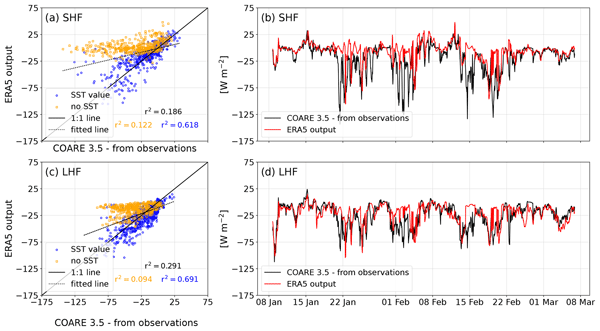
Few observations exist in the Amundsen Sea. Consequently, studies rely on reanalysis (e.g., ERA5) to investigate how the atmosphere affects ocean variability (e.g., sea-ice formation and melt). We use data collected along ice shelves to show that cold, dry air blowing from Antarctica triggers large ocean heat loss, which is underestimated by ERA5. We then use an ocean model to show that this bias has an important impact on the ocean, with implications for sea-ice forecasts.
Manoj Joshi, Robert A. Hall, David P. Stevens, and Ed Hawkins
Earth Syst. Dynam., 14, 443–455, https://doi.org/10.5194/esd-14-443-2023, https://doi.org/10.5194/esd-14-443-2023, 2023
Short summary
Short summary
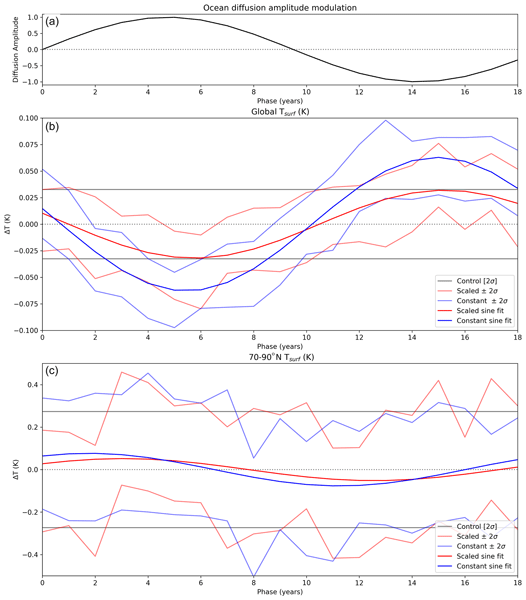
The 18.6-year lunar nodal cycle arises from variations in the angle of the Moon's orbital plane and affects ocean tides. In this work we use a climate model to examine the effect of this cycle on the ocean, surface, and atmosphere. The timing of anomalies is consistent with the so-called slowdown in global warming and has implications for when global temperatures will exceed 1.5 ℃ above pre-industrial levels. Regional anomalies have implications for seasonal climate areas such as Europe.

Peter M. F. Sheehan, Gillian M. Damerell, Philip J. Leadbitter, Karen J. Heywood, and Rob A. Hall
Ocean Sci., 19, 77–92, https://doi.org/10.5194/os-19-77-2023, https://doi.org/10.5194/os-19-77-2023, 2023
Short summary
Short summary
We calculate the rate of turbulent kinetic energy dissipation, i.e. the mixing driven by small-scale ocean turbulence, in the western tropical Atlantic Ocean via two methods. We find good agreement between the results of both. A region of elevated mixing is found between 200 and 500 m, and we calculate the associated heat and salt fluxes. We find that double-diffusive mixing in salt fingers, a common feature of the tropical oceans, drives larger heat and salt fluxes than the turbulent mixing.
Callum Rollo, Karen J. Heywood, and Rob A. Hall
Geosci. Instrum. Method. Data Syst., 11, 359–373, https://doi.org/10.5194/gi-11-359-2022, https://doi.org/10.5194/gi-11-359-2022, 2022
Short summary
Short summary
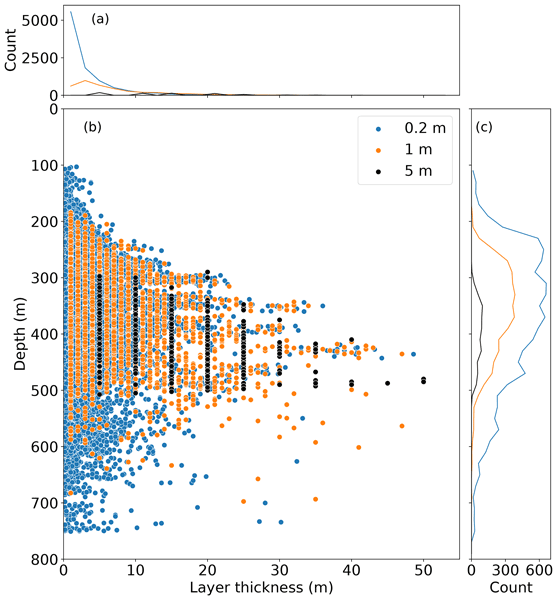
Using an underwater buoyancy-powered autonomous glider, we collected profiles of temperature and salinity from the ocean north-east of Barbados. Most of the temperature and salinity profiles contained staircase-like structures of alternating constant values and large gradients. We wrote an algorithm to identify these staircases. We hypothesise that these staircases are prevented from forming where background gradients in temperature and salinity are too great.
Elise S. Droste, Mario Hoppema, Melchor González-Dávila, Juana Magdalena Santana-Casiano, Bastien Y. Queste, Giorgio Dall'Olmo, Hugh J. Venables, Gerd Rohardt, Sharyn Ossebaar, Daniel Schuller, Sunke Trace-Kleeberg, and Dorothee C. E. Bakker
Ocean Sci., 18, 1293–1320, https://doi.org/10.5194/os-18-1293-2022, https://doi.org/10.5194/os-18-1293-2022, 2022
Short summary
Short summary
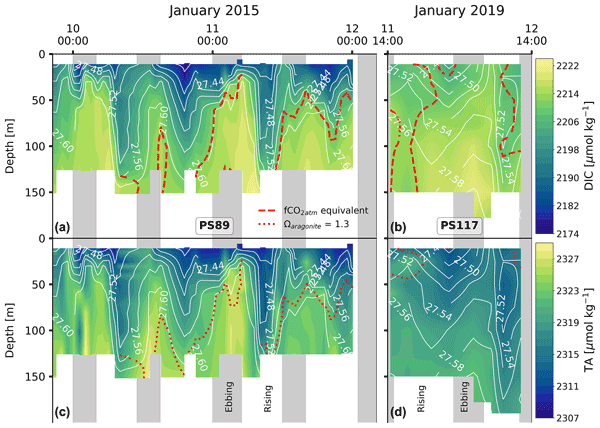
Tides affect the marine carbonate chemistry of a coastal polynya neighbouring the Ekström Ice Shelf by movement of seawater with different physical and biogeochemical properties. The result is that the coastal polynya in the summer can switch between being a sink or a source of CO2 multiple times a day. We encourage consideration of tides when collecting in polar coastal regions to account for tide-driven variability and to avoid overestimations or underestimations of air–sea CO2 exchange.
Benjamin R. Loveday, Timothy Smyth, Anıl Akpinar, Tom Hull, Mark E. Inall, Jan Kaiser, Bastien Y. Queste, Matt Tobermann, Charlotte A. J. Williams, and Matthew R. Palmer
Earth Syst. Sci. Data, 14, 3997–4016, https://doi.org/10.5194/essd-14-3997-2022, https://doi.org/10.5194/essd-14-3997-2022, 2022
Short summary
Short summary
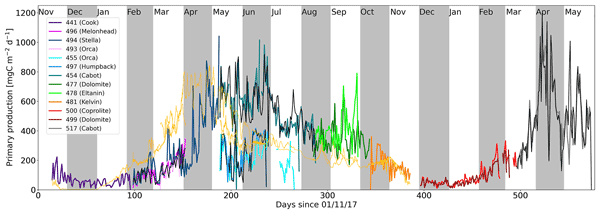
Using a new approach to combine autonomous underwater glider data and satellite Earth observations, we have generated a 19-month time series of North Sea net primary productivity – the rate at which phytoplankton absorbs carbon dioxide minus that lost through respiration. This time series, which spans 13 gliders, allows for new investigations into small-scale, high-frequency variability in the biogeochemical processes that underpin the carbon cycle and coastal marine ecosystems in shelf seas.
Yixi Zheng, David P. Stevens, Karen J. Heywood, Benjamin G. M. Webber, and Bastien Y. Queste
The Cryosphere, 16, 3005–3019, https://doi.org/10.5194/tc-16-3005-2022, https://doi.org/10.5194/tc-16-3005-2022, 2022
Short summary
Short summary
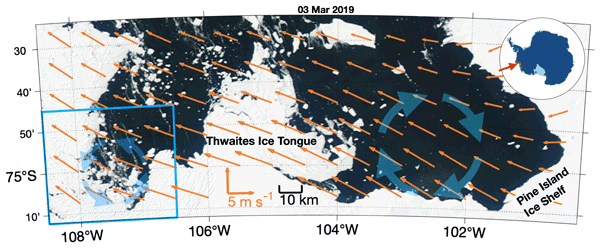
New observations reveal the Thwaites gyre in a habitually ice-covered region in the Amundsen Sea for the first time. This gyre rotates anticlockwise, despite the wind here favouring clockwise gyres like the Pine Island Bay gyre – the only other ocean gyre reported in the Amundsen Sea. We use an ocean model to suggest that sea ice alters the wind stress felt by the ocean and hence determines the gyre direction and strength. These processes may also be applied to other gyres in polar oceans.
Cited articles
Al-Hashmi, K. A., Piontkovski, S. A., Bruss, G., Hamza, W., Al-Junaibi, M., Bryantseva, Y., and Popova, E.: Seasonal Variations of Plankton Communities in Coastal Waters of Oman, International Journal of Oceans and Oceanography, 13, 395–426, http://www.ripublication.com/ijoo19/ijoov13n2_13.pdf (last access: 20 June 2025), 2019. a, b
Ansong, J. K., Arbic, B. K., Alford, M. H., Buijsman, M. C., Shriver, J. F., Zhao, Z., Richman, J. G., Simmons, H. L., Timko, P. G., Wallcraft, A. J., and Zamudio, L.: Semidiurnal Internal Tide Energy Fluxes and Their Variability in a Global Ocean Model and Moored Observations, Journal of Geophysical Research: Oceans, 122, 1882–1900, https://doi.org/10.1002/2016JC012184, 2017. a
Becherer, J., Moum, J. N., Calantoni, J., Colosi, J. A., Barth, J. A., Lerczak, J. A., McSweeney, J. M., MacKinnon, J. A., and Waterhouse, A. F.: Saturation of the Internal Tide over the Inner Continental Shelf. Part I: Observations, Journal of Physical Oceanography, https://doi.org/10.1175/JPO-D-20-0264.1, 2021a. a, b, c, d
Becherer, J., Moum, J. N., Calantoni, J., Colosi, J. A., Barth, J. A., Lerczak, J. A., McSweeney, J. M., MacKinnon, J. A., and Waterhouse, A. F.: Saturation of the Internal Tide over the Inner Continental Shelf. Part II: Parameterization, Journal of Physical Oceanography, https://doi.org/10.1175/JPO-D-21-0047.1, 2021b. a, b, c, d, e, f, g
Bordbar, M. H., Nasrolahi, A., Lorenz, M., Moghaddam, S., and Burchard, H.: The Persian Gulf and Oman Sea: Climate Variability and Trends Inferred from Satellite Observations, Estuarine, Coastal and Shelf Science, 296, 108588, https://doi.org/10.1016/j.ecss.2023.108588, 2024. a
Bruss, G., Al-Buwaiqi, B., Al-Abdali, F., Al-Khusaibi, S., Queste, B., and Font, E.: Current measurements and hydrographic data on the Al-Batinah Shelf, Oman, Zenodo [data set], https://doi.org/10.5281/zenodo.17864274, 2025. a
Cai, S., Xie, J., and He, J.: An Overview of Internal Solitary Waves in the South China Sea, Surveys in Geophysics, 33, 927–943, https://doi.org/10.1007/s10712-012-9176-0, 2012. a, b
Chitrakar, P., Baawain, M. S., Sana, A., and Al-Mamun, A.: Hydrodynamic Measurements and Modeling in the Coastal Regions of Northern Oman, Journal of Ocean Engineering and Marine Energy, 6, 99–119, https://doi.org/10.1007/s40722-020-00161-z, 2020. a
Claereboudt, M. R.: Monitoring The Vertical Thermal Structure of the Water Column in Coral Reef Environments Using Divers of Opportunity, Current Trends in Oceanography and Marine Sciences, 107, https://www.gavinpublishers.com/article/view/monitoring-the-vertical-thermal-structure-of-the-water-column-in-coral-reef-environments-using-divers-of-opportunity (last access: 23 December 2025), 2018. a
Codiga, D. L.: Unified Tidal Analysis and Prediction Using the UTide Matlab Functions, https://doi.org/10.13140/RG.2.1.3761.2008, 2011. a, b
Coles, S. L.: Reef Corals Occurring in a Highly Fluctuating Temperature Environment at Fahal Island, Gulf of Oman (Indian Ocean), Coral Reefs, 16, 269–272, https://doi.org/10.1007/s003380050084, 1997. a
Colosi, J. A., Kumar, N., Suanda, S. H., Freismuth, T. M., and MacMahan, J. H.: Statistics of Internal Tide Bores and Internal Solitary Waves Observed on the Inner Continental Shelf off Point Sal, California, Journal of Physical Oceanography, 48, 123–143, https://doi.org/10.1175/JPO-D-17-0045.1, 2018. a
Cushman-Roisin, B. and Beckers, J.-M.: Internal Waves, in: International Geophysics, Vol. 101, Elsevier, 395–424, ISBN 978-0-12-088759-0, https://doi.org/10.1016/B978-0-12-088759-0.00013-4, 2011. a, b, c
DiBattista, J., Berumen, M., Priest, M., De Brauwer, M., Coker, D., Sinclair-Taylor, T., Hay, A., Bruss, G., Mansour, S., Bunce, M., Goatley, C., Power, M., and Marshell, A.: Environmental DNA Reveals a Multi-Taxa Biogeographic Break across the Arabian Sea and Sea of Oman, Environmental DNA, 4, 206–221, https://doi.org/10.1002/edn3.252, 2022. a
DiMarco, S. F., Wang, Z., Chapman, P., al-Kharusi, L., Belabbassi, L., al-Shaqsi, H., Stoessel, M., Ingle, S., Jochens, A. E., and Howard, M. K.: Monsoon-Driven Seasonal Hypoxia along the Northern Coast of Oman, Frontiers in Marine Science, 10, 1248005, https://doi.org/10.3389/fmars.2023.1248005, 2023. a, b, c
Duda, T., Lynch, J., Irish, J., Beardsley, R., Ramp, S., Chiu, C.-S., Tang, T., and Yang, Y.-J.: Internal Tide and Nonlinear Internal Wave Behavior at the Continental Slope in the Northern South China Sea, IEEE Journal of Oceanic Engineering, 29, 1105–1130, https://doi.org/10.1109/JOE.2004.836998, 2004. a, b, c, d, e, f
Duda, T. F. and Rainville, L.: Diurnal and Semidiurnal Internal Tide Energy Flux at a Continental Slope in the South China Sea, Journal of Geophysical Research: Oceans, 113, 2007JC004418, https://doi.org/10.1029/2007JC004418, 2008. a, b
Egbert, G. D. and Erofeeva, S. Y.: Efficient Inverse Modeling of Barotropic Ocean Tides, Journal of Atmospheric and Oceanic Technology, 19, 183–204, https://doi.org/10.1175/1520-0426(2002)019<0183:EIMOBO>2.0.CO;2, 2002. a, b
Font, E., Queste, B. Y., and Swart, S.: Seasonal to Intraseasonal Variability of the Upper Ocean Mixed Layer in the Gulf of Oman, Journal of Geophysical Research: Oceans, 127, e2021JC018045, https://doi.org/10.1029/2021JC018045, 2022. a, b
Font, E., Swart, S., Bruss, G., Sheehan, P. M. F., Heywood, K. J., and Queste, B. Y.: Ventilation of the Arabian Sea Oxygen Minimum Zone by Persian Gulf Water, Journal of Geophysical Research: Oceans, 129, e2023JC020668, https://doi.org/10.1029/2023JC020668, 2024. a, b
Garrett, C. and Kunze, E.: Internal Tide Generation in the Deep Ocean, Annual Review of Fluid Mechanics, 39, 57–87, https://doi.org/10.1146/annurev.fluid.39.050905.110227, 2007. a
GEBCO: The GEBCO_2024 Grid – a Continuous Terrain Model of the Global Oceans and Land, British Oceanographic Data Centre, https://doi.org/10.5285/1C44CE99-0A0D-5F4F-E063-7086ABC0EA0F, 2024. a
Gerkema, T.: Application of an Internal Tide Generation Model to Baroclinic Spring-neap Cycles, Journal of Geophysical Research: Oceans, 107, https://doi.org/10.1029/2001JC001177, 2002. a
Gerkema, T., Staquet, C., and Bouruet-Aubertot, P.: Decay of Semi-diurnal Internal-tide Beams Due to Subharmonic Resonance, Geophysical Research Letters, 33, 2005GL025105, https://doi.org/10.1029/2005GL025105, 2006. a
Gong, Y., Rayson, M. D., Jones, N. L., and Ivey, G. N.: The Effects of Remote Internal Tides on Continental Slope Internal Tide Generation, Journal of Physical Oceanography, 49, 1651–1668, https://doi.org/10.1175/JPO-D-18-0180.1, 2019. a
Good, S., Fiedler, E., Mao, C., Martin, M. J., Maycock, A., Reid, R., Roberts-Jones, J., Searle, T., Waters, J., While, J., and Worsfold, M.: The Current Configuration of the OSTIA System for Operational Production of Foundation Sea Surface Temperature and Ice Concentration Analyses, Remote Sensing, 12, 720, https://doi.org/10.3390/rs12040720, 2020. a, b
Hamada, T. and Kim, S.: Stratification Potential-Energy Anomaly Index Standardized by External Tide Level, Estuarine, Coastal and Shelf Science, 250, 107138, https://doi.org/10.1016/j.ecss.2020.107138, 2021. a
Holloway, P., Pelinovsky, E., and Talipova, T.: Internal Tide Transformation and Oceanic Internal Solitary Waves, in: Environmental Stratified Flows, vol. 3, edited by: Grimshaw, R., Kluwer Academic Publishers, Boston, 29–60, ISBN 978-0-7923-7605-7, https://doi.org/10.1007/0-306-48024-7_2, 2003. a, b, c
Inall, M., Aleynik, D., Boyd, T., Palmer, M., and Sharples, J.: Internal Tide Coherence and Decay over a Wide Shelf Sea: INTERNAL TIDE DECAY, Geophysical Research Letters, 38, https://doi.org/10.1029/2011GL049943, 2011. a
Johns, W., Jacobs, G., Kindle, J., Murray, S., and Carron, M.: Arabian Marginal Seas and Gulfs: Report of a Workshop Held at Stennis Space Center, Miss, 11–13 May, 1999, Technical Report 2000-01, University of Miami RSMAS, https://www2.whoi.edu/site/bower-lab/wp-content/uploads/sites/12/2018/03/TechRpt_ArabianMarginal.pdf (last access: 20 June 2025), 1999. a
Kelly, S. M. and Nash, J. D.: Internal-tide Generation and Destruction by Shoaling Internal Tides, Geophysical Research Letters, 37, 2010GL045598, https://doi.org/10.1029/2010GL045598, 2010. a, b
Kelly, S. M., Jones, N. L., Ivey, G. N., and Lowe, R. J.: Internal-Tide Spectroscopy and Prediction in the Timor Sea, Journal of Physical Oceanography, 45, 64–83, https://doi.org/10.1175/JPO-D-14-0007.1, 2015. a
Koohestani, K., Stepanyants, Y., and Allahdadi, M. N.: Analysis of Internal Solitary Waves in the Gulf of Oman and Sources Responsible for Their Generation, Water, 15, 746, https://doi.org/10.3390/w15040746, 2023. a, b
Kunze, E., Rosenfeld, L. K., Carter, G. S., and Gregg, M. C.: Internal Waves in Monterey Submarine Canyon, Journal of Physical Oceanography, 32, 1890–1913, https://doi.org/10.1175/1520-0485(2002)032<1890:IWIMSC>2.0.CO;2, 2002. a, b
Lauton, G., Pattiaratchi, C. B., and Lentini, C. A. D.: Observations of Breaking Internal Tides on the Australian North West Shelf Edge, Frontiers in Marine Science, 8, 629372, https://doi.org/10.3389/fmars.2021.629372, 2021. a
L'Hégaret, P., Lacour, L., Carton, X., Roullet, G., Baraille, R., and Corréard, S.: A Seasonal Dipolar Eddy near Ras Al Hamra (Sea of Oman), Ocean Dynamics, 63, 633–659, https://doi.org/10.1007/s10236-013-0616-2, 2013. a
L'Hégaret, P., Carton, X., Louazel, S., and Boutin, G.: Mesoscale eddies and submesoscale structures of Persian Gulf Water off the Omani coast in spring 2011, Ocean Sci., 12, 687–701, https://doi.org/10.5194/os-12-687-2016, 2016. a
Li, M., Hou, Y., Li, Y., and Hu, P.: Energetics and Temporal Variability of Internal Tides in Luzon Strait: A Nonhydrostatic Numerical Simulation, Chinese Journal of Oceanology and Limnology, 30, 852–867, https://doi.org/10.1007/s00343-012-1289-2, 2012. a, b
Martini, K. I., Alford, M. H., Kunze, E., Kelly, S. M., and Nash, J. D.: Internal Bores and Breaking Internal Tides on the Oregon Continental Slope, Journal of Physical Oceanography, 43, 120–139, https://doi.org/10.1175/JPO-D-12-030.1, 2013. a, b
Masunaga, E., Tamura, H., and Uchiyama, Y.: Shoaling Internal Tides Propagating From a Shallow Ridge Modulated by the Kuroshio, Journal of Geophysical Research: Oceans, 129, e2023JC020409, https://doi.org/10.1029/2023JC020409, 2024. a
McDougall, T. J. and Barker, P. M.: Getting Started with TEOS-10 and the Gibbs Seawater (GSW) Oceanographic Toolbox, SCOR/IAPSO Working Group 127, Technical Series No. 9, ISBN 978-0-646-55621-5, 2011. a
McSweeney, J. M., Lerczak, J. A., Barth, J. A., Becherer, J., Colosi, J. A., MacKinnon, J. A., MacMahan, J. H., Moum, J. N., Pierce, S. D., and Waterhouse, A. F.: Observations of Shoaling Nonlinear Internal Bores across the Central California Inner Shelf, Journal of Physical Oceanography, 50, 111–132, https://doi.org/10.1175/JPO-D-19-0125.1, 2020. a, b, c, d, e, f
Müller, M.: The Influence of Changing Stratification Conditions on Barotropic Tidal Transport and Its Implications for Seasonal and Secular Changes of Tides, Continental Shelf Research, 47, 107–118, https://doi.org/10.1016/j.csr.2012.07.003, 2012. a
Murphy, A. H.: Skill Scores Based on the Mean Square Error and Their Relationships to the Correlation Coefficient, Monthly Weather Review, 116, 2417–2424, https://doi.org/10.1175/1520-0493(1988)116<2417:SSBOTM>2.0.CO;2, 1988. a
Piontkovski, S. A. and Chiffings, T.: Long-Term Changes of Temperature in the Sea of Oman and the Western Arabian Sea, International Journal of Oceans and Oceanography, 8, 53–72, 2014. a
Pous, S. P., Carton, X., and Lazure, P.: Hydrology and Circulation in the Strait of Hormuz and the Gulf of Oman – Results from the GOGP99 Experiment: 1. Strait of Hormuz, Journal of Geophysical Research: Oceans, 109, 2003JC002145, https://doi.org/10.1029/2003JC002145, 2004. a, b, c, d
Queste, B. Y., Vic, C., Heywood, K. J., and Piontkovski, S. A.: Physical Controls on Oxygen Distribution and Denitrification Potential in the North West Arabian Sea, Geophysical Research Letters, 45, 4143–4152, https://doi.org/10.1029/2017GL076666, 2018. a
Rainville, L. and Pinkel, R.: Propagation of Low-Mode Internal Waves through the Ocean, Journal of Physical Oceanography, 36, 1220–1236, https://doi.org/10.1175/JPO2889.1, 2006. a
Rayson, M. D., Jones, N. L., Ivey, G. N., and Gong, Y.: A Seasonal Harmonic Model for Internal Tide Amplitude Prediction, Journal of Geophysical Research: Oceans, 126, e2021JC017570, https://doi.org/10.1029/2021JC017570, 2021. a, b, c
Shapiro, G. I., Huthnance, J. M., and Ivanov, V. V.: Dense Water Cascading off the Continental Shelf, Journal of Geophysical Research: Oceans, 108, 2002JC001610, https://doi.org/10.1029/2002JC001610, 2003. a
Shroyer, E. L., Moum, J. N., and Nash, J. D.: Observations of Polarity Reversal in Shoaling Nonlinear Internal Waves, Journal of Physical Oceanography, 39, 691–701, https://doi.org/10.1175/2008JPO3953.1, 2009. a, b
Simpson: The Shelf-Sea Fronts: Implications of Their Existence and Behaviour, Philosophical Transactions of the Royal Society of London. Series A, Mathematical and Physical Sciences, 302, 531–546, https://doi.org/10.1098/rsta.1981.0181, 1981. a
Siyanbola, O. Q., Buijsman, M. C., Delpech, A., Barkan, R., Pan, Y., and Arbic, B. K.: Interactions of Remotely Generated Internal Tides With the U.S. West Coast Continental Margin, Journal of Geophysical Research: Oceans, 129, e2023JC020859, https://doi.org/10.1029/2023JC020859, 2024. a, b
Small, J. and Martin, J.: The Generation of Non-Linear Internal Waves in the Gulf of Oman, Continental Shelf Research, 22, 1153–1182, https://doi.org/10.1016/S0278-4343(01)00094-2, 2002. a, b, c
Stephenson, G. R., Green, J. A. M., and Inall, M. E.: Systematic Bias in Baroclinic Energy Estimates in Shelf Seas, Journal of Physical Oceanography, 46, 2851–2862, https://doi.org/10.1175/JPO-D-15-0215.1, 2016. a
Storlazzi, C. D., Cheriton, O. M., Van Hooidonk, R., Zhao, Z., and Brainard, R.: Internal Tides Can Provide Thermal Refugia That Will Buffer Some Coral Reefs from Future Global Warming, Scientific Reports, 10, 13435, https://doi.org/10.1038/s41598-020-70372-9, 2020. a
Subeesh, M. P., Song, H., Addad, Y., Scott, J. R., Marshall, J., and Al Shehhi, M. R.: Seasonality of Internal Tides in the Strait of Hormuz: Observations and Modeling, Journal of Geophysical Research: Oceans, 130, e2024JC021007, https://doi.org/10.1029/2024JC021007, 2025. a, b, c
Vlasenko, V., Hutter, K., and Stashchuk, N.: Baroclinic Tides: Theoretical Modeling and Observational Evidence, Cambridge University Press, New York, ISBN 978-0-521-84395-9, 978-0-511-12623-9, 2005. a
Walter, R. K., Woodson, C. B., Leary, P. R., and Monismith, S. G.: Connecting Wind-Driven Upwelling and Offshore Stratification to Nearshore Internal Bores and Oxygen Variability, Journal of Geophysical Research: Oceans, 119, 3517–3534, https://doi.org/10.1002/2014JC009998, 2014. a
Wang, W., Robertson, R., Wang, Y., Zhao, C., Hao, Z., Yin, B., and Xu, Z.: Distinct Variability between Semidiurnal and Diurnal Internal Tides at the East China Sea Shelf, Remote Sensing, 14, 2570, https://doi.org/10.3390/rs14112570, 2022. a
Xie, X. H., Cuypers, Y., Bouruet-Aubertot, P., Pichon, A., Lourenço, A., and Ferron, B.: Generation and Propagation of Internal Tides and Solitary Waves at the Shelf Edge of the B Ay of B Iscay, Journal of Geophysical Research: Oceans, 120, 6603–6621, https://doi.org/10.1002/2015JC010827, 2015. a
Short summary
We studied internal tides in the Gulf of Oman, where they had not been observed in detail before. Using seabed instruments, we found that these underwater waves travel far inshore, strengthen as the season shifts toward fall, and stay predictable for weeks. They may bring cooler, low-oxygen water to coastal areas, influencing marine ecosystems and reef health.
We studied internal tides in the Gulf of Oman, where they had not been observed in detail...


