Articles | Volume 10, issue 5
https://doi.org/10.5194/os-10-799-2014
© Author(s) 2014. This work is distributed under
the Creative Commons Attribution 3.0 License.
https://doi.org/10.5194/os-10-799-2014
© Author(s) 2014. This work is distributed under
the Creative Commons Attribution 3.0 License.
Flow dynamics around downwelling submarine canyons
J. M. Spurgin
Department of Earth, Ocean and Atmospheric Sciences, University of British Columbia, Vancouver, British Columbia, Canada
S. E. Allen
Department of Earth, Ocean and Atmospheric Sciences, University of British Columbia, Vancouver, British Columbia, Canada
Related authors
No articles found.
Karyn D. Suchy, Susan E. Allen, Akash R. Sastri, and Kelly V. Young
Biogeosciences, 23, 4667–4689, https://doi.org/10.5194/bg-23-4667-2026, https://doi.org/10.5194/bg-23-4667-2026, 2026
Short summary
Short summary
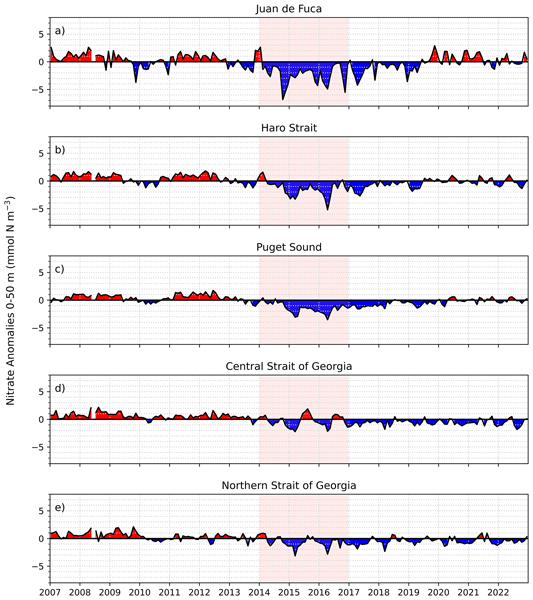
We used a biophysical model to examine the impacts of the 2014–2017 Northeast Pacific Marine Heatwave on plankton in the Salish Sea. Warming was strongest in the Juan de Fuca Strait, increasing phytoplankton growth. The Strait of Georgia showed stronger links to the North Pacific Gyre Oscillation with warming beyond 2017 and a reduction in large phytoplankton. Results highlight that multiple marine heatwaves can overlap within one waterbody, each with distinct effects on the local food web.
Anna Lina Petruseviciute Sjur, Pål Erik Isachsen, Johan Nilsson, and Susan Allen
EGUsphere, https://doi.org/10.5194/egusphere-2026-778, https://doi.org/10.5194/egusphere-2026-778, 2026
Short summary
Short summary
Ocean currents along continental slopes do not respond symmetrically to changing winds. This asymmetry arises from interactions between the flow and seafloor bumps. Using simplified simulations, we show that this asymmetry manifests differently for short and long wind forcing periods. These effects are likely missed in coarse-grained climate models, with implications for representing ocean flow in the Arctic.
Becca Beutel, Susan E. Allen, Jilian Xiong, Jay T. Cullen, and Tia Anderlini
Biogeosciences, 22, 7309–7336, https://doi.org/10.5194/bg-22-7309-2025, https://doi.org/10.5194/bg-22-7309-2025, 2025
Short summary
Short summary
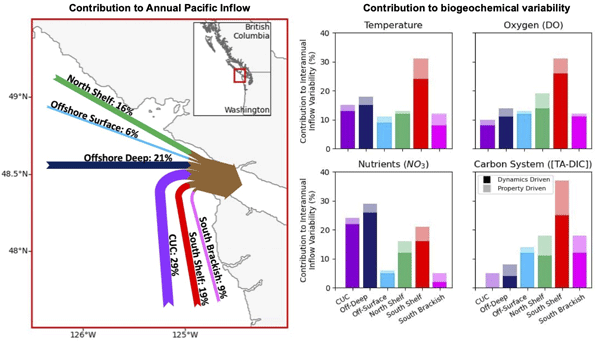
This study examines how variability in Pacific source waters influences the biogeochemistry of the Salish Sea. Using model simulations and observations, we traced the origins and properties of inflowing water and quantified the roles of circulation and property variability in shaping fluxes of oxygen, nutrients, and carbonate system tracers. These findings highlight key drivers of interannual change and their relevance under a changing climate.
Pedro A. Figueroa, Gonzalo S. Saldías, and Susan E. Allen
Ocean Sci., 21, 643–659, https://doi.org/10.5194/os-21-643-2025, https://doi.org/10.5194/os-21-643-2025, 2025
Short summary
Short summary
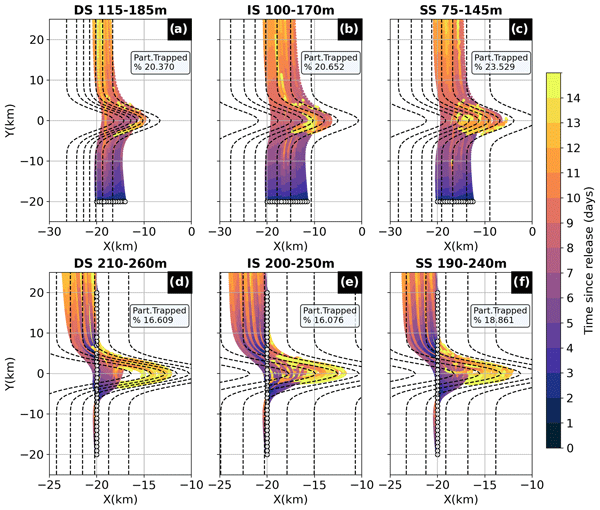
Submarine canyons are topographic features found along the continental slope worldwide. Here we use numerical simulations to study how a submarine canyon influences the circulation near the coast when winds moving poleward influence the region. Our results show that submarine canyons modify the circulation near the coast, causing strong velocities perpendicular to the coast. These changes can trap particles inside the canyon, an important mechanism to explain its role as a biological hotspot.
Laura Bianucci, Jennifer M. Jackson, Susan E. Allen, Maxim V. Krassovski, Ian J. W. Giesbrecht, and Wendy C. Callendar
Ocean Sci., 20, 293–306, https://doi.org/10.5194/os-20-293-2024, https://doi.org/10.5194/os-20-293-2024, 2024
Short summary
Short summary
While the deeper waters in the coastal ocean show signs of climate-change-induced warming and deoxygenation, some fjords can keep cool and oxygenated waters in the subsurface. We use a model to investigate how these subsurface waters created during winter can linger all summer in Bute Inlet, Canada. We found two main mechanisms that make this fjord retentive: the typical slow subsurface circulation in such a deep, long fjord and the further speed reduction when the cold waters are present.
Tereza Jarníková, Elise M. Olson, Susan E. Allen, Debby Ianson, and Karyn D. Suchy
Ocean Sci., 18, 1451–1475, https://doi.org/10.5194/os-18-1451-2022, https://doi.org/10.5194/os-18-1451-2022, 2022
Short summary
Short summary
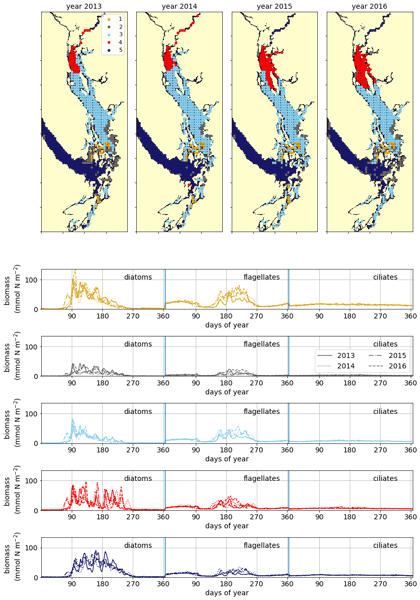
Understanding drivers of phytoplankton biomass in dynamic coastal regions is key to predicting present and future ecosystem functioning. Using a clustering-based method, we objectively determined biophysical provinces in a complex estuarine sea. The Salish Sea contains three major distinct provinces where phytoplankton dynamics are controlled by diverse stratification regimes. Our method is simple to implement and broadly applicable for identifying structure in large model-derived datasets.
Ben Moore-Maley and Susan E. Allen
Ocean Sci., 18, 143–167, https://doi.org/10.5194/os-18-143-2022, https://doi.org/10.5194/os-18-143-2022, 2022
Short summary
Short summary
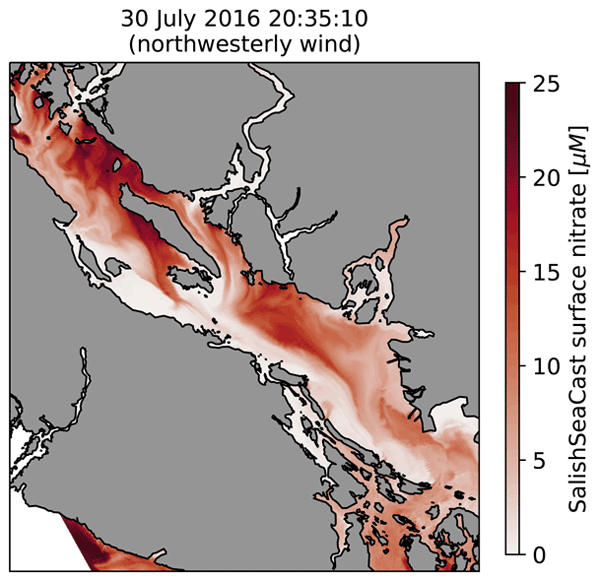
Inland seas are critical habitats for globally important fisheries, and the local food webs that support these fisheries are often limited by surface nutrient availability. In the Strait of Georgia, which supports several key northern Pacific fisheries, we identify wind-driven upwelling as a dominant source of summer surface nutrients using a high-resolution coupled ecosystem model. This newly identified underlying mechanism will inform interpretations of ecosystem variability in the region.
Cited articles
Adcroft, A., Hill, C., Campin, J.-M., Marshall, J., and Heimbach, P.: Overview of the formulation and numerics of the MIT GCM, in: Proceedings of the ECMWF seminar series on Numerical Methods, Recent developments in numerical methods for atmosphere and ocean modelling, 139–149, 2004.
Allen, S. E.: Topographically generated, subinertial flows within a finite length canyon, J. Phys. Oceanogr., 26, 1608–1632, 1996.
Allen, S. E. and Durrieu de Madron, X.: A review of the role of submarine canyons in deep-ocean exchange with the shelf, Ocean Sci., 5, 607–620, https://doi.org/10.5194/os-5-607-2009, 2009.
Allen, S. E., Vindeirinho, C., Thomson, R. E., Foreman, M. G., and Mackas, D. L.: Physical and biological processes over a submarine canyon during an upwelling event, Can. J. Fish. Aquat. Sci., 58, 671–684, 2001.
Alvarez, A., Tintoré, J., and Sabatés, A.: Flow modification and shelf-slope exchange induced by a submarine canyon off the northeast Spanish coast, J. Geophys. Res.-Oceans, 101, 12043–12055, https://doi.org/10.1029/95JC03554, 1996.
Ardhuin, F., Pinot, J.-M., and Tintoré, J.: Numerical study of the circulation in a steep canyon off the Catalan coast (western Mediterranean), J. Geophys. Res.-Oceans, 104, 11115–11135, https://doi.org/10.1029/1999JC900029, 1999.
Bosley, K. L., Lavelle, J. W., Brodeur, R. D., Wakefield, W. W., Emmett, R. L., Baker, E. T., and Rehmke, K. M.: Biological and physical processes in and around Astoria submarine canyon, Oregon, U}S{A, J. Marine Syst., 50, 21–37, 2004.
Boyer, D. L., Haidvogel, D. B., and Perenne, N.: Laboratory-numerical model comparisons of canyon flows: a parameter study, J. Phys. Oceanogr., 34, 1588–1609, 2004.
Company, J. B., Ramirez-Llodra, E., Sarda, F., Aguzzi, J., Puig, P., Canals, M., Calafat, A., Palanques, A., Sole, M., Sanchez-Vidal, A., Martin, J., Lastras, G., Tecchio, S., Koening, S., Fernandez-Arcaya, U., Mecho, A., and Fernandez, P.: Submarine canyons in the Catalan Sea (NW Mediterranean): megafaunal biodiversity patterns and anthropogenic threats, in: Mediterranean Submarine Canyons: Ecology and Governance, edited by: Wurtz, M., IUCN, Gland, Switzerland, Málaga, Spain, 133–144, 2012.
Dawe, J. T. and Allen, S. E.: Solution convergence of flow over steep topography in a numerical model of canyon upwelling, J. Geophys. Res.-Oceans, 115, C05008, https://doi.org/10.1029/2009JC005597, 2010.
Flexas, M. M., Boyer, D. L., Espino, M., Puigdefàbregas, J., Rubio, A., and Company, J. B.: Circulation over a submarine canyon in the NW Mediterranean, J. Geophys. Res.-Oceans, 113, https://doi.org/10.1029/2006JC003998, 2008.
Freeland, H. and Denman, K.: A topographically controlled upwelling center off southern Vancouver Island, J. Mar. Res., 40, 1069–1093, 1982.
Granata, T. C., Vidondo, B., Duarte, C. M., Satta, M. P., and Garcia, M.: Hydrodynamics and particle transport associated with a submarine canyon off Blanes (Spain), N}W {Mediterranean Sea, Cont. Shelf Res., 19, 1249–1263, 1999.
Gregg, M. C., Hall, R. A., Carter, G. S., Alford, M. H., Lien, R.-C., Winkel, D. P., and Wain, D. J.: Flow and mixing in Ascension, a steep, narrow canyon, J. Geophys. Res.-Oceans, 116, C07016, https://doi.org/10.1029/2010JC006610, 2011.
Griffies, S. M. and Hallberg, R. W.: Biharmonic friction with a Smagorinsky-like viscosity for use in large-scale eddy-permitting ocean models, Mon. Weather Rev., 128, 2935–2946, 2000.
Hickey, B.: Coastal submarine canyons, in: Topographic Effects in the Ocean, SOEST Special publications, 95–110, 1995.
Howatt, T. M. and Allen, S. E.: Impact of the continental shelf slope on upwelling through submarine canyons, J. Geophys. Res.-Oceans, 118, 5814–5828, https://doi.org/10.1002/jgrc.20401, 2013.
Ianson, D., Allen, S. E., Mackas,D. L., Trevorrow, M. V., and Benfield, M. C.: Response of Euphausia pacifica to small-scale shear in turbulent flow over a sill in a fjord, J. Plank. Res., 11, 1679–1695, https://doi.org/10.1093/plankt/fbr074, 2011.
Jordi, A., Orfila, A., Basterretxea, G., and Tintoré, J.: Shelf-slope exchanges by frontal variability in a steep submarine canyon, Prog. Oceanogr., 66, 120–141, 2005.
Kämpf, J.: Transient wind-driven upwelling in a submarine canyon: A process-oriented modeling study, J. Geophys. Res.-Ocean., 111, C11011, https://doi.org/10.1029/2006JC003497, 2006.
Klinck, J. M.: Circulation near submarine canyons: a modeling study, J. Geophys. Res.-Oceans, 101, 1211–1223, https://doi.org/10.1029/95JC02901, 1996.
Le Souëf, K. E. and Allen, S. E.: Physical modeling of tidal resonance in a submarine canyon, J. Geophys. Res.-Oceans, 119, 1324–1343, https://doi.org/10.1002/2013JC009612, 2014.
Mann, K.: Overview of results, in: Advances in Understanding the Gully Ecosystem: a Summary of Research Projects Conducted at the Bedford Institute of Oceanography (1999–2001), edited by: Gordon, D. and Fenton, D., Fisheries and Oceans Canada, Ottawa, p. 72, 2002.
Orlanski, I.: A simple boundary condition for unbounded hyperbolic flows, J. Comput. Phys., 21, 251–269, 1976.
She, J. and Klinck, J. M.: Flow near submarine canyons driven by constant winds, J. Geophys. Res.-Oceans, 105, 28671–28694, https://doi.org/10.1029/2000JC900126, 2000.
Skliris, N. and Djenidi, S.: Plankton dynamics controlled by hydrodynamic processes near a submarine canyon off N}{W corsican coast: A numerical modelling study, Cont. Shelf Res., 26, 1336–1358, 2006.
Skliris, N., Goffart, A., Hecq, J. H., and Djenidi, S.: Shelf-slope exchanges associated with a steep submarine canyon off Calvi (Corsica, NW Mediterranean Sea): a modeling approach, J. Geophys. Res.-Oceans, 106, 19883–19901, https://doi.org/10.1029/2000JC000534, 2001.
Skliris, N., Hecq, J., and Djenidi, S.: Water fluxes at an ocean margin in the presence of a submarine canyon, J. Marine Syst., 32, 239–251, 2002.
Smagorinsky, J.: General circulation experiments with the primitive equations, Mon. Weather Rev., 91, 99–164, https://doi.org/10.1175/1520-0493(1963)091<0099:GCEWTP>2.3.CO;2, 1963.
Spurgin, J.: Flow dynamics around downwelling submarine canyons, Master's thesis, University of British Columbia, 2014.